|
Contact Us Table of Contents Search Site Google listing of all pages on this website Site Map Toby Johnson's Facebook page Toby Johnson's YouTube channel Toby Johnson on Wikipedia Toby Johnson Amazon Author Page  Secure site at https://tobyjohnson.com  Also on this website: As an Amazon Associate
I earn from qualifying purchases. Toby Johnson's books: Toby's books are available as ebooks from smashwords.com, the Apple iBookstore, etc. FINDING
YOUR OWN TRUE MYTH: What I Learned
from Joseph Campbell: The
Myth
of the
Great Secret
III GAY SPIRITUALITY: The Role of Gay Identity in the Transformation of Human Consciousness
GAY PERSPECTIVE: Things Our Homosexuality Tells Us about the Nature of God and the Universe
SECRET MATTER, a sci-fi novel with wonderful "aliens" with an Afterword by Mark Jordan
GETTING
LIFE IN PERSPECTIVE:
A
Fantastical Gay Romance set in two different time periods
THE FOURTH QUILL, a novel about attitudinal healing and the problem of evil  TWO SPIRITS: A Story of Life with the Navajo, a collaboration with Walter L. Williams  CHARMED LIVES: Spinning Straw into Gold: GaySpirit in Storytelling, a collaboration with Steve Berman and some 30 other writers
THE MYTH OF THE GREAT SECRET: An Appreciation of Joseph Campbell
IN SEARCH OF GOD IN THE SEXUAL UNDERWORLD: A Mystical Journey
Books on Gay Spirituality: White Crane Gay Spirituality Series
Articles and Excerpts:
Review of Samuel Avery's The Dimensional Structure of Consciousness Funny Coincidence: "Aliens Settle in San Francisco" About Liberty Books, the Lesbian/Gay Bookstore for Austin, 1986-1996 The Simple Answer to the Gay Marriage Debate A Bifurcation of Gay Spirituality Why gay people should NOT Marry The Scriptural Basis for Same Sex Marriage
Gay ConsciousnessQ&A about Jungian ideas in gay consciousness What Jesus said about Gay Rights Common Experiences Unique to Gay Men Is there a "uniquely gay perspective"? Interview on the Nature of Homosexuality What the Bible Says about Homosexuality Mesosexual Ideal for Straight Men Waves of Gay Liberation Activity Wouldn’t You Like to Be Uranian? The Reincarnation of Edward Carpenter Why Gay Spirituality: Spirituality as Artistic Medium Easton Mountain Retreat Center Andrew Harvey & Spiritual Activism The Mysticism of Andrew Harvey
Enlightenment
Joseph Campbell's description of Avalokiteshvara You're Not A WaveJoseph Campbell Talks about Aging What is Enlightenment? What is reincarnation? How many lifetimes in an ego? Emptiness & Religious Ideas Experiencing experiencing experiencing Going into the Light Meditations for a Funeral Meditation Practice The way to get to heaven Buddha's father was right What Anatman means Advice to Travelers to India & Nepal The Danda Nata & goddess Kalika Nate Berkus is a bodhisattva John Boswell was Immanuel Kant Cutting edge realization The Myth of the Wanderer Change: Source of Suffering & of Bliss World Navel What the Vows Really Mean Manifesting from the Subtle Realms The Three-layer Cake & the Multiverse The est Training and Personal Intention Effective Dreaming in Ursula LeGuin's The Lathe of Heaven Gay
Spirituality
|
 Dark Knowledge Dark KnowledgeBy Kenneth Low Author House, 308 pages, 978-1456755676 Available from authorhouse.com Also available for Kindle from amazon.com Reviewed by Toby Johnson The Life of Christ is a literary genre all of its own. Down through Christian history, authors—historians, spiritual writers, mystics, religious officials, heretics and orthodox alike—have variously told the story of the life of Jesus as a way of conveying a particular emphasis or special insight into the nature of religion and of the good Christian life. Dark Knowledge is such a book. It’s an unusual—and for that reason alone, quite interesting—take on the life of Jesus Christ for two major reasons. Because of the suspenseful style in which the book is written I want to avoid giving away the meaning of the title. But without explaining how these fit together, I want to highlight the two reasons I found the book so intriguing and why I want to recommend it to other readers. Within gay cultural circles, it’s become almost commonplace to understand that, in some way, Jesus was kind of gay (whether sexually active or not). This assumption uses the Life of Christ genre then to describe traits, skills and predilections that go with gay personality as positive spiritual qualities: if Jesus was sensitive and kind, for instance, then the commonly experienced trait among gay people of sensitivity to others’ feelings can be understood as Christ-like. Another part of this obvious—but to most people outrageous—assumption might be to elucidate actual history in order to explain Jesus’s teachings: if Jesus was aware of homosexual dynamics in his—and the occupying Romans’—cultures, his healing the servant boy-lover of the Roman Centurion showed respect and acceptance of gay orientation. In so many books, like Kittredge Cherry’s Jesus in Love, Paul Hartman’s The Kairos, Theodore Jennings’ The Man Jesus Loved, John Henson’s The Gay Disciple, Jesus is portrayed as a sort of “proud and affirming,” self-aware, sex-positive gay man with a message of overcoming dualism and religious oppression. Kenneth Low’s Dark Knowledge deals with the possibility that Jesus was homosexual in a very different way. Low’s life of Christ is framed in a close analysis of Jewish-Greco-Roman culture and political history. When Low considers Jesus as homosexual, it is as secretive, shamed and closeted, what a homosexual would have thought of himself in an intensely and threateningly homophobic and misogynistic society. His townsfolk would have ignored his teachings because they knew too much about him. He’d have been an embarrassment to his family. The Apostles would have been reluctant to admit they knew him if this fact came out. In this reading of the story, Jesus’s homosexuality isn’t an item of pride, but rather the source of a spiritual crisis that forces him to develop an interpretation of virtue and goodness that isn’t just conformity with Jewish Law, since he himself can’t conform. Low adopts an assumption about Jesus that also appears in Cherry’s novels: that he was actively aware of being the Son of God and incarnation of the Blessed Trinity. Cherry uses this to imagine a dramatic mystical interior life for Jesus. While highly respectful of who Jesus was, Low uses this to explain his surprising ability to quote from the Hebrew Scriptures, his teaching through parables that don’t make sense to most of his audience (including his own Apostles), and his tendency to be aloof and demanding. Since he knows he is God incarnate, he has an inherent need and expectation to be worshipped. That he knows he is God and, possibly, knows he is homosexual gives him a unique view of the old Jewish religion. The other reason this book is so intriguing—even while I disagree with the fundamental assumption—is that Low treats the gospels, especially that of Matthew, as though they were realtime narratives. So, for instance, when Jesus predicts his own imminent death, he must know something about the plot that will result in this; if he didn’t know he were about to be arrested, he couldn’t have known what was going to be happen next. The gospels are treated like a mystery novel, full of clues to be uncovered and fit together like puzzle pieces to reveal the “real” reason Jesus was executed. The book is written a little like a legal brief or solution to a puzzle, suspensefully presenting information about the Jesus of Scripture and the surrounding political and cultural dynamics in order to arrive at the revelation of the secret meaning of Jesus’s mission as world savior—what Kenneth Low calls the “dark knowledge.” This is a different way of approaching the life of Christ from any I have ever seen. It certainly results in a different interpretation of the story and presentation of the personality of Jesus, though not one all that inconsistent with Christian values and aspirations. To use a sort of cliché of book reviewers, Low’s life of Christ is “refreshingly” modern and honest. One of the things he is especially honest about is that the parables in which Jesus taught as portrayed in the Matthew gospel are not at all clear or meaningful. We all like the Beatitudes and the Golden Rule and Jesus’s prediction of the Last Judgment as pithy summaries of his teaching the gospel of love; but most of us would have a hard time explaining Christian teaching using stories like the wheat and the tares or the wise and foolish bridesmaids. Low focuses at great length on the story of the sower and the seed. What are all those odd stories trying to say anyway? For those interested in the history of what was really going in New Testament times and those who love a good mystery, this book is a sort of must-read. In the end, I found myself agreeing with Low’s conclusions about the story behind the story. I am skeptical of his assumptions about the historical person of Jesus. But since nobody knows—say, whether he experienced being God-incarnate and had a need to be worshipped—any opinion is worthwhile if it elucidates the story. I am certainly skeptical of Low’s assertion that Jesus’s ability to quote from the Torah and the prophets shows godlike powers because I don’t buy the premise that the gospels are realtime narratives. The various books about Jesus were written years after his life and death. The writers knew how the story turned out. For Jesus to have quoted texts from Isaiah to prove he was the Messiah doesn’t prove Jesus was intimately familiar with the writings of Isaiah or that he thought he was the fulfillment of these words, but that later, in retrospect, Matthew, Mark, Luke and John could put these words into his mouth in their narrative and even portray him as fulfilling the prophecies because they were constructing the whole narrative after the fact. I don’t believe Kenneth Low has discovered the correct way to understand the secret story of Jesus Christ, but I do think the way he engages the life-of-Christ genre adds new levels to how we understand the story. Though not written as a novel, Dark Knowledge is parallel to the beloved and notorious The Last Temptation of Christ by Nikos Kazantzakis; the story is told so differently from how the reader had heard it in catechism class or Sunday School or portrayed in movies like The Greatest Story Ever Told, that he or she is bound to discover insights and new interpretations. Whether you agree with Low’s conclusions about the “dark knowledge,” you’ll find the arguments and suspenseful presentation a really good read. |
Toby Johnson, PhD is author of nine books: three non-fiction books that apply the wisdom of his teacher and "wise old man," Joseph Campbell to modern-day social and religious problems, four gay genre novels that dramatize spiritual issues at the heart of gay identity, and two books on gay men's spiritualities and the mystical experience of homosexuality and editor of a collection of "myths" of gay men's consciousness.
Johnson's book
GAY
SPIRITUALITY: The Role of Gay Identity in the Transformation of
Human Consciousness won a Lambda Literary Award in 2000.
His GAY
PERSPECTIVE: Things Our [Homo]sexuality Tells Us about the Nature
of God and the Universe was nominated for a Lammy in 2003. They
remain
in
print.









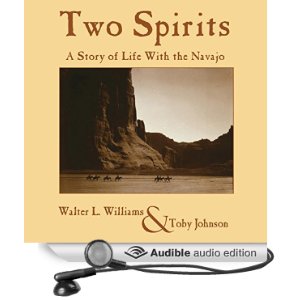 Two
Spirits is available as an
audiobook narrated by Arthur Raymond.
Two
Spirits is available as an
audiobook narrated by Arthur Raymond.