Contact Us
Table of Contents
Search Site
Google listing of all pages on this website
Site Map
Toby
Johnson's Facebook page
Toby
Johnson's YouTube channel
Toby Johnson on Wikipedia
Toby
Johnson Amazon Author Page

Secure site at
https://tobyjohnson.com
Also on this
website:
As an Amazon Associate
I earn from qualifying purchases.
Toby
Johnson's books:
Toby's books are available as ebooks from
smashwords.com, the Apple iBookstore, etc.
FINDING
YOUR OWN TRUE MYTH: What I Learned
from Joseph Campbell: The
Myth
of the
Great Secret
III
GAY
SPIRITUALITY:
The Role of Gay Identity in the Transformation of Human Consciousness

GAY PERSPECTIVE:
Things Our Homosexuality Tells Us about the Nature of God and the
Universe

SECRET MATTER, a sci-fi novel with
wonderful "aliens" with an
Afterword by Mark Jordan
GETTING
LIFE IN PERSPECTIVE:
A
Fantastical Gay Romance set in two different time periods

THE FOURTH QUILL, a
novel about attitudinal healing and the problem of evil
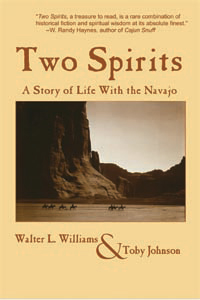
TWO SPIRITS: A Story of Life with
the
Navajo, a collaboration with Walter L. Williams

CHARMED
LIVES: Spinning Straw into
Gold: GaySpirit in Storytelling, a collaboration with
Steve Berman and some 30 other writers
THE MYTH OF THE GREAT
SECRET:
An
Appreciation of Joseph Campbell
IN SEARCH OF GOD IN THE
SEXUAL UNDERWORLD: A Mystical Journey
Unpublished manuscripts
About ordering
Books on
Gay Spirituality:
White
Crane Gay Spirituality Series

Articles
and Excerpts:
Review of Samuel
Avery's The
Dimensional Structure of Consciousness
Funny
Coincidence: "Aliens Settle in San Francisco"
About Liberty Books, the
Lesbian/Gay Bookstore for Austin, 1986-1996
The Simple Answer to the Gay Marriage Debate
A
Bifurcation of Gay Spirituality
Why gay people should NOT Marry
The Scriptural Basis for
Same Sex Marriage
Toby and Kip Get Married
Wedding Cake Liberation
Gay Marriage in Texas
What's ironic
Shame on the American People
The "highest form of love"
Gay Consciousness
Why homosexuality is a sin
The cause of homosexuality
The
origins of homophobia
Q&A
about Jungian ideas in gay consciousness
What
is homosexuality?
What
is Gay Spirituality?
My three
messages
What
Jesus said about Gay
Rights
Queering
religion
Common
Experiences Unique to Gay
Men
Is there a "uniquely gay
perspective"?
The
purpose of homosexuality
Interview on the Nature of
Homosexuality
What the Bible Says about
Homosexuality
Mesosexual
Ideal for Straight Men
Varieties
of Gay Spirituality
Waves
of Gay Liberation Activity
The Gay Succession
Wouldn’t You Like to Be Uranian?
The Reincarnation of
Edward Carpenter
Why Gay Spirituality: Spirituality
as Artistic Medium
Easton Mountain Retreat Center
Andrew Harvey &
Spiritual Activism
The Mysticism of
Andrew Harvey
The
upsidedown book on MSNBC
Enlightenment
"It's
Always About You"
The myth of the Bodhisattva
Avalokitesvara
Joseph
Campbell's description of
Avalokiteshvara
You're
Not A Wave
Joseph Campbell Talks
about Aging
What is Enlightenment?
What is reincarnation?
How many lifetimes in an
ego?
Emptiness & Religious Ideas
Experiencing experiencing experiencing
Going into the Light
Meditations for a Funeral
Meditation Practice
The way to get to heaven
Buddha's father was right
What Anatman means
Advice to Travelers to India
& Nepal
The Danda Nata
& goddess Kalika
Nate Berkus is a bodhisattva
John Boswell was Immanuel Kant
Cutting
edge realization
The Myth of the
Wanderer
Change: Source of
Suffering & of Bliss
World Navel
What the Vows Really
Mean
Manifesting
from the Subtle Realms
The Three-layer
Cake
& the Multiverse
The
est Training and Personal Intention
Effective
Dreaming in Ursula LeGuin's The Lathe of Heaven
Gay
Spirituality
Curious
Bodies
What
Toby Johnson Believes
The
Joseph Campbell Connection
The
Mann Ranch (& Rich Gabrielson)
Campbell
& The Pre/Trans Fallacy
The
Two Loves
The
Nature of Religion
What's true about
Religion
Being
Gay is a Blessing
Drawing Long Straws
Freedom
of Religion
The
Gay Agenda
Gay
Saintliness
Gay
Spiritual Functions
The subtle workings of the spirit
in gay men's lives.
The Sinfulness of
Homosexuality
Proposal
for a study of gay nondualism
Priestly Sexuality
Having a Church to
Leave
Harold Cole on Beauty
Marian Doctrines:
Immaculate Conception & Assumption
Not lashed to the
prayer-post
Monastic or Chaste
Homosexuality
Is It Time to Grow
Up? Confronting
the Aging Process
Notes on Licking
(July, 1984)
Redeem Orlando
Gay Consciousness changing
the
world by Shokti LoveStar
Alexander Renault
interviews Toby
Johnson
Mystical Vision
"The
Evolution of Gay Identity"
"St. John of the
Cross & the Dark Night of
the Soul."
Avalokiteshvara
at the Baths
Eckhart's Eye
Let Me
Tell You a Secret
Religious
Articulations of the
Secret
The
Collective Unconscious
Driving as
Spiritual Practice
Meditation
Historicity
as Myth
Pilgrimage
No
Stealing
Next
Step in Evolution
The
New Myth
The Moulting of the Holy Ghost
Gaia
is a Bodhisattva
The Hero's
Journey
The
Hero's Journey as archetype -- GSV 2016
The Gay Hero Journey
(shortened)
You're
On Your Own
Superheroes
Seeing
Differently
Teenage
Prostitution and the Nature of Evil
Allah
Hu: "God is present here"
Adam
and Steve
The Life is
in the Blood
Gay retirement and the "freelance
monastery"
Seeing with
Different Eyes
Facing
the Edge: AIDS as an occasion for spiritual wisdom
What
are you looking for in a gay science fiction novel?
The Vision
The
mystical experience at the Servites' Castle in Riverside
A Most Remarkable
Synchronicity in
Riverside
The
Great Dance according to C.S.Lewis
The Techniques Of The
World Saviors
Part 1: Brer Rabbit and the
Tar-Baby
Part 2: The
Bodhisattva Avalokiteshvara
Part 3: Jesus
and the Resurrection
Part 4: A
Course in Miracles
The
Secret of the Clear Light
Understanding
the Clear Light
Mobius
Strip
Finding
Your
Tiger Face
How Gay Souls Get Reincarnated
Joseph
Campbell, the Hero's Journey, and the modern Gay Hero-- a five part
presentation on YouTube
About Alien Abduction
In
honor of Sir Arthur C Clarke
Karellen was a homosexual
The
D.A.F.O.D.I.L. Alliance
Intersections
with the movie When We Rise
More
about Gay Mental Health
Psych
Tech Training
Toby
at the California Institute
The
Rainbow Flag
Ideas for gay
mythic stories
People
Kip and Toby,
Activists
Toby's
friend and nicknamesake Toby Marotta.
Harry
Hay, Founder of the gay movement
About Hay and The New Myth
About
Karl
Heinrich Ulrichs, the first
man to really "come out"
About Michael Talbot, gay mystic
About Fr. Bernard Lynch
About Richard Baltzell
About Guy Mannheimer
About David Weyrauch
About
Dennis Paddie
About Ask the Fire
About
Arthur Evans
About
Christopher Larkin
About Mark Thompson
About Sterling Houston
About Michael Stevens
The Alamo Business
Council
Our friend Tom Nash
Second March on
Washington
The
Gay
Spirituality Summit in May 2004 and the "Statement
of Spirituality"
Book
Reviews
Be Done on Earth by Howard
E. Cook
Pay Me What I'm Worth by
Souldancer
The Way Out by Christopher
L Nutter
The Gay Disciple by John Henson
Art That Dares by Kittredge Cherry
Coming Out, Coming Home by Kennth
A. Burr
Extinguishing
the Light by B. Alan Bourgeois
Over Coffee: A conversation
For Gay
Partnership & Conservative Faith by D.a. Thompson
Dark Knowledge
by
Kenneth Low
Janet Planet by
Eleanor
Lerman
The
Kairos by Paul E. Hartman
Wrestling
with Jesus by D.K.Maylor
Kali Rising by Rudolph
Ballentine
The
Missing Myth by Gilles Herrada
The
Secret of the Second Coming by Howard E. Cook
The Scar Letters: A
Novel
by Richard Alther
The
Future is Queer by Labonte & Schimel
Missing Mary
by Charlene Spretnak
Gay
Spirituality 101 by Joe Perez
Cut Hand: A
Nineteeth Century Love Story on the American Frontier by Mark Wildyr
Radiomen
by Eleanor Lerman
Nights
at
Rizzoli by Felice Picano
The Key
to Unlocking the Closet Door by Chelsea Griffo
The Door
of the Heart by Diana Finfrock Farrar
Occam’s
Razor by David Duncan
Grace
and
Demion by Mel White
Gay Men and The New Way Forward by Raymond L.
Rigoglioso
The
Dimensional Stucture of Consciousness by Samuel Avery
The
Manly Pursuit of Desire and Love by Perry Brass
Love
Together: Longtime Male Couples on Healthy Intimacy and Communication
by Tim Clausen
War
Between Materialism and Spiritual by Jean-Michel Bitar
The
Serpent's Gift: Gnostic Reflections on the Study of Religion by
Jeffrey J. Kripal
Esalen:
America and the Religion of No Religion by Jeffrey J. Kripal
The
Invitation to Love by
Darren Pierre
Brain,
Consciousness, and God: A Lonerganian Integration by Daniel A
Helminiak
A
Walk with Four Spiritual Guides by Andrew Harvey
Can Christians Be Saved? by Stephenson & Rhodes
The
Lost Secrets of the Ancient Mystery Schools by Stephenson &
Rhodes
Keys to
Spiritual
Being: Energy Meditation and Synchronization Exercises by Adrian
Ravarour
In
Walt We
Trust by John Marsh
Solomon's
Tantric Song by Rollan McCleary
A Special Illumination by Rollan McCleary
Aelred's
Sin
by Lawrence Scott
Fruit
Basket
by Payam Ghassemlou
Internal
Landscapes by John Ollom
Princes
& Pumpkins by David Hatfield Sparks
Yes by Brad
Boney
Blood of the Goddess by William Schindler
Roads of Excess,
Palaces of
Wisdom by Jeffrey Kripal
Evolving
Dharma by Jay Michaelson
Jesus
in Salome's Lot by Brett W. Gillette
The Man Who Loved Birds by Fenton Johnson
The
Vatican Murders by Lucien Gregoire
"Sex Camp"
by
Brian McNaught
Out
& About with Brewer & Berg
Episode One: Searching for a New Mythology
The
Soul Beneath the Skin by David Nimmons
Out
on
Holy Ground by Donald Boisvert
The
Revotutionary Psychology of Gay-Centeredness by Mitch Walker
Out There
by Perry Brass
The Crucifixion of Hyacinth by Geoff Puterbaugh
The
Silence of Sodom by Mark D Jordan
It's
Never About What It's About by Krandall Kraus and Paul Borja
ReCreations,
edited by Catherine Lake
Gospel: A
Novel
by WIlton Barnhard
Keeping
Faith: A Skeptic’s Journey by Fenton Johnson
Dating the Greek Gods by Brad Gooch
Telling
Truths in Church by Mark D. Jordan
The
Substance of God by Perry Brass
The
Tomcat Chronicles by Jack Nichols
10
Smart
Things Gay Men Can Do to Improve Their Lives by Joe Kort
Jesus and the Shamanic Tradition of Same Sex Love
by Will Roscoe
The
Third Appearance by Walter Starcke
The Last Hours of Ancient Sunlight by Thom Hartmann
Surviving
and Thriving After a Life-Threatening Diagnosis by Bev Hall
Men,
Homosexuality, and the Gods by Ronald Long
An Interview
with Ron Long
Queering Creole Spiritual Traditons by Randy
Conner & David Sparks
An Interview with
Randy Conner
Pain,
Sex
and Time by Gerald Heard
Sex
and the Sacred by Daniel Helminiak
Blessing Same-Sex Unions by Mark Jordan
Rising Up
by
Joe Perez
Soulfully
Gay
by Joe Perez
That
Undeniable Longing by Mark Tedesco
Vintage: A
Ghost
Story by
Steve Berman
Wisdom
for the Soul by Larry Chang
MM4M a DVD
by Bruce Grether
Double
Cross
by David Ranan
The
Transcended Christian by Daniel Helminiak
Jesus
in Love by Kittredge Cherry
In
the Eye of the Storm by Gene Robinson
The
Starry Dynamo by Sven Davisson
Life
in
Paradox by Fr Paul Murray
Spirituality for Our Global Community by Daniel
Helminiak
Gay & Healthy in a Sick Society by Robert A.
Minor
Coming Out: Irish Gay Experiences by Glen O'Brien
Queering
Christ
by Robert Goss
Skipping
Towards Gomorrah by Dan Savage
The
Flesh of the Word by Richard A Rosato
Catland by
David Garrett Izzo
Tantra
for Gay Men by Bruce Anderson
Yoga
&
the Path of the Urban Mystic by Darren Main
Simple
Grace
by Malcolm Boyd
Seventy
Times Seven by Salvatore Sapienza
What
Does "Queer" Mean Anyway? by Chris Bartlett
Critique of Patriarchal Reasoning by Arthur Evans
Gift
of
the Soul by Dale Colclasure & David Jensen
Legend of the Raibow Warriors by Steven McFadden
The
Liar's
Prayer by Gregory Flood
Lovely
are the Messengers by Daniel Plasman
The Human Core of Spirituality by Daniel Helminiak
3001:
The Final Odyssey by Arthur C. Clarke
Religion and the Human Sciences by Daniel Helminiak
Only
the
Good Parts by Daniel Curzon
Four
Short
Reviews of Books with a Message
Life
Interrupted by Michael Parise
Confessions of a Murdered Pope by Lucien Gregoire
The
Stargazer's Embassy by Eleanor Lerman
Conscious
Living, Conscious Aging by Ron Pevny
Footprints Through the Desert by Joshua Kauffman
True
Religion by J.L. Weinberg
The Mediterranean Universe by John Newmeyer
Everything
is God by Jay Michaelson
Reflection
by Dennis Merritt
Everywhere
Home by Fenton Johnson
Hard Lesson by James
Gaston
God
vs Gay?
by Jay Michaelson
The
Gate
of Tears: Sadness and the Spiritual Path by Jay Michaelson
Roxie
&
Fred by Richard Alther
Not
the Son He Expected by Tim Clausen
The
9 Realities of Stardust by Bruce P. Grether
The
Afterlife Revolution by Anne & Whitley Strieber
AIDS
Shaman:
Queer Spirit Awakening by Shokti Lovestar
Facing the Truth of Your Life by Merle Yost
The
Super Natural by Whitley Strieber & Jeffrey J Kripal
Secret
Body by
Jeffrey J Kripal
In
Hitler's
House by Jonathan Lane
Walking on Glory by Edward Swift
The
Paradox
of Porn by Don Shewey
Is Heaven for Real? by Lucien Gregoire
Scissors,
Paper, Rock by Fenton Johnson
Toby
Johnson's
Books on Gay Men's Spiritualities:
Gay Perspective
Things Our [Homo]sexuality
Tells Us
about the
Nature of God and
the Universe
Gay
Perspective is available as an audiobook narrated
by Matthew Whitfield. Click
here
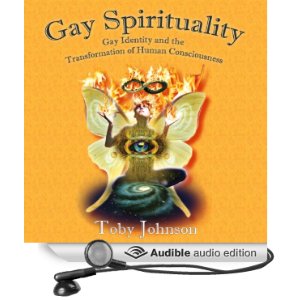
Gay Spirituality
Gay Identity and
the Transformation of
Human Consciousness
Gay
Spirituality is now
available as an audiobook, beautifully narrated by John Sipple. Click here
Charmed
Lives: Gay Spirit in Storytelling
edited by
Toby Johnson
& Steve Berman
Secret
Matter
Lammy Award Winner for Gay
Science Fiction
updated
Getting Life in
Perspective
A Fantastical Romance
Getting
Life in Perspective is available as an
audiobook narrated by Alex Beckham. Click
here
The Fourth Quill
originally published
as
PLAGUE

The Fourth Quill is
available
as an audiobook, narrated by Jimmie
Moreland. Click here
Two Spirits: A Story of
Life
with the Navajo
with Walter L. Williams
 Two
Spirits is available as an
audiobook narrated by Arthur Raymond. Click
here Two
Spirits is available as an
audiobook narrated by Arthur Raymond. Click
here
Finding
Your Own True Myth: What I Learned from Joseph
Campbell
The
Myth
of the
Great Secret III
In Search of God in the Sexual Underworld
The Myth of the Great
Secret: An Appreciation of Joseph Campbell.
This
was the second edition of this book.
Toby Johnson's
titles are
available in other ebook formats from Smashwords.
|
Our Travels to India &
Nepal
(December 7, 2006) Kip and I have just returned from
a two
week tourist excursion to India and Nepal. We bought the tourist
package from a travel agency called Postcard Destinations.
We've been happy with their services and so I am pleased to recommend
them. This is our second trip with Postcard Destinations. We did a
Christmas time tour of Southern Germany and Bavaria a couple of years
which we bought through Postcard Destinations. That was also a
wonderful trip--Christmas in the Black Forest! (Just perfect, there as
even "real Black Forest cake"). Nicholas at Postcard Destinations does
offer just that: postcard-perfect vacations.
This recent tour was arranged by a company called Gate 1. The actual
name of the tour was India's
Majesty with Nepal. (Click on title for specific itinerary &
brochure)
We certainly saw a lot of "majesty," not least of which, of course, was
the famed Taj Mahal and the peak of Mount Everest. The trip took us
from Delhi to Jaipur to Agra to Khajuraho to Varanasi,
then to Kathmandu.
We also saw a lot of squalor and human suffering. India is certainly a
case study for the problem of overpopulation and human crowding. AND
the injustice of Man to man.
Everywhere we went the busload of some 30 mostly American and Canadian
tourists were beset upon by hawkers and beggars. The guide, a very
lovely and intelligent and well-spoken middle-aged Indian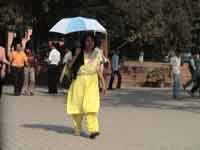 Brahmin
woman named Mridula Punj (who led us around with her blue & white
parasol), warned us against giving too much money to the beggars
because of the danger of attracting more and more of them and creating
discord and fighting among them over the litlte pittances of alms we
might give out. And she appropriately warned us that the hawkers
couldn't be trusted with prices and the best way to buy from them was
to wait till the bus was about to leave and she would present the
various wares to us at the most reasonable prices. Brahmin
woman named Mridula Punj (who led us around with her blue & white
parasol), warned us against giving too much money to the beggars
because of the danger of attracting more and more of them and creating
discord and fighting among them over the litlte pittances of alms we
might give out. And she appropriately warned us that the hawkers
couldn't be trusted with prices and the best way to buy from them was
to wait till the bus was about to leave and she would present the
various wares to us at the most reasonable prices.
So we certainly were given sensible advice about how to deal with the
hawkers and beggars. BUT this advice -- and the hawkers' constant
pestering and refusal to accept "no, thanks, I'm not interested" --
created an upsetting adversarial relationship with them and with India
in general.
Prices for items would begin at $90 US, for instance, for a wooden
flute presented by a young man who followed me throughout the entire
visit to the temple square of one of the original cities of Kathmandu,
the price constantly coming down and his insistence I buy the thing
constantly increasing. I finally gave in and bought the flute for $1.50.
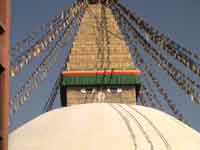 At the wonderful Buddhist stupa in downtown
Kathmandu with the eyes of Buddha painted on the square finial at the
top (featured in the movie "Little Buddha"), a site that felt truly
holy to me, I bought two silver medallions with the eyes of Buddha from
a hawker for $40. Later I bought the same medallion elsewhere for a
hundred rupees, about $1.25. At the wonderful Buddhist stupa in downtown
Kathmandu with the eyes of Buddha painted on the square finial at the
top (featured in the movie "Little Buddha"), a site that felt truly
holy to me, I bought two silver medallions with the eyes of Buddha from
a hawker for $40. Later I bought the same medallion elsewhere for a
hundred rupees, about $1.25.
It was hard not to feel like we were being cheated--and the holiness of
the various locales "desecrated."
Mrs Punj explained that the "professional beggars" are sometimes
children who have been maimed by their parents to make them good
beggars and so giving them money only reinforces a cultural economic
pattern that does more harm than good. Though to the boy with crippled
legs or the lepers with stumps for hands, the alms would provide needed
resources. (I think they didn't have the luxury of considering
socio-economic dynamics.)
It also made us feel guilty that we weren't giving more. And I could
imagine how the Indians must have felt resentful of us. Here we are
Americans with enough money to fly to their country and walk around
with expensive cameras taking pictures of them and not wanting to give
away a few pennies here and there, walking past the poor lepers as
though they were bothersome insects, not human beings wth complex
conscious experience. No wonder the "wretched of the Earth" are
resentful and angry with America--and easily turned to side with Al
Qeda and opponents of the U.S. It isn't our "freedom" they hate, it's
our "stinginess." And the stinginess is born out of fear and confusion
and bafflement at what to do in the face of such suffering and poverty.
Kip and I came away with a realization that we'd handled this issue all
wrong. We saw there was a better way. And so I'm posting this message
of advice to tourists to India in hopes of making the next travelers'
experience more satisfying.
THE ADVICE
Take about a hundred dollars -- the amount you'd donate to a politician
without even thinking about it, the amount that a nice dinner would
cost -- with you in small bills, $1s or $5s. And plan to give it away
and buy the little trinkets freely. Maybe even buy more trinkets than
you can possibly use, and gather them in a bag and leave the bag on a
ledge someplace where somebody will find it. You might even provide
some beggar the "capital" he or she needs to get started in small
business. Almost like making a mini-loan that doesn't have to be repaid.
Don't let the adversarial quality of the hawking and begging get to
you. Just give the money away generously. It will make YOUR trip better.
A SECOND PIECE OF ADVICE
We flew from Texas to Paris to Delhi and then back again. That's how
airlines set up travel. The trip going was with the wind and took us
just over a day. The trip coming back was against the wind and took
nearly a full day longer. We should have kept flying east.
If we'd left Kathmandu for Bangkok and then flown home across the
Pacific, we'd have "circumnavigated" the globe. That would have gotten
us home faster, I think, and added a "notch" to our travel experience.
THE TRIP
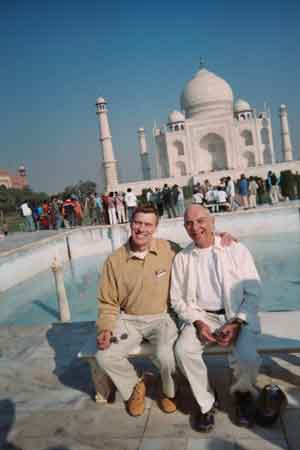
The excursion to India and Nepal was a highlight of our lives, I think,
though as I write this I am suffering with a cold I caught on the plane
and still feeling a little jet-lagged.
We were with a group of about 30 tourists, most of them married couples
of late middle age. We were one of three gay couples. (One of the other
gay couples was on a buying junket for their Oriental gift shop in New
Orleans, Silk Road
Collection. They seemed to be having fun cause they were buying
freely. They've posted a nice description
of their experience of the tour.) It was nice being with nongay
people on the tour. I think we all gave them good examples of what
gayness really is. Travel is a good opportunity for educational "coming
out." The gay couples in the group were all uniformly liked and honored
by everybody.
MY READING
As it happened I was reading the most perfect book for this excursion
-- The Years of Rice and Saltby Kim Stanley Robinson. It's an
alternative history of planet Earth, based on the hypothesis that the
Black Plague that struck Western Europe in the 14th Century had wiped
out the population entirely and took Christianity and European culture
with it. The dominant forces in the world of Robinson's novel are
Islam, Buddhism, and Native American culture.
What is especially interesting is how the novel follows a set of 4 or 5
characters into the bardo and through their stream of reincarnations
from the time of plague to just beyond the present. So the book
discusses reincarnation mythology again and again, becoming more and
more sophisticated as time passes and culture develops. It's a real
tour de force (and at 763 pages enough reading to last through many
plane flights and layovers).
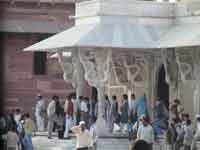
Some of the sites we visited -- specifically the Tomb of Chisti,
founder of Sufism, at Fatepur Sikri between Agra and Khajuraho -- are
actually in the novel. (This is the entrance to the tomb shown in the
photo)
I came away from the experience understanding that what I am as a
conscious ego-person is a fulfillment of the hopes and fears and
struggles of all those people who've lived before.
The trip wasn't as "spiritual" as I'd hoped, because the hawkers
created such distractions even in the most holy of places -- like Deer
Park in Varanasi, the birthplace of Buddhism (and maybe the tomb of
Buddha). But the spiritual wisdom shone through nonetheless and not in
small part in the advice I have offered above about buying more
trinkets and giving them back to another set of hawkers. Those poor
people are me!
I hope you'll want to follow in our footsteps! Bon voyage!
|