|
Contact Us Table of Contents Search Site Google listing of all pages on this website Site Map Toby Johnson's Facebook page Toby Johnson's YouTube channel Toby Johnson on Wikipedia Toby Johnson Amazon Author Page  Secure site at https://tobyjohnson.com  Also on this website: As an Amazon Associate
I earn from qualifying purchases. Toby Johnson's books: Toby's books are available as ebooks from smashwords.com, the Apple iBookstore, etc. FINDING
YOUR OWN TRUE MYTH: What I Learned
from Joseph Campbell: The
Myth
of the
Great Secret
III GAY SPIRITUALITY: The Role of Gay Identity in the Transformation of Human Consciousness
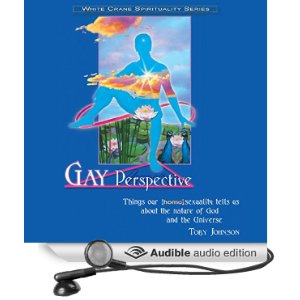
GAY PERSPECTIVE: Things Our Homosexuality Tells Us about the Nature of God and the Universe
SECRET MATTER, a sci-fi novel with wonderful "aliens" with an Afterword by Mark Jordan
GETTING
LIFE IN PERSPECTIVE:
A
Fantastical Gay Romance set in two different time periods
THE FOURTH QUILL, a novel about attitudinal healing and the problem of evil  TWO SPIRITS: A Story of Life with the Navajo, a collaboration with Walter L. Williams  CHARMED LIVES: Spinning Straw into Gold: GaySpirit in Storytelling, a collaboration with Steve Berman and some 30 other writers
THE MYTH OF THE GREAT SECRET: An Appreciation of Joseph Campbell
IN SEARCH OF GOD IN THE SEXUAL UNDERWORLD: A Mystical Journey
Books on Gay Spirituality: White Crane Gay Spirituality Series
Articles and Excerpts:
Review of Samuel Avery's The Dimensional Structure of Consciousness Funny Coincidence: "Aliens Settle in San Francisco" About Liberty Books, the Lesbian/Gay Bookstore for Austin, 1986-1996 The Simple Answer to the Gay Marriage Debate A Bifurcation of Gay Spirituality Why gay people should NOT Marry The Scriptural Basis for Same Sex Marriage
Gay ConsciousnessQ&A about Jungian ideas in gay consciousness What Jesus said about Gay Rights Common Experiences Unique to Gay Men Is there a "uniquely gay perspective"? Interview on the Nature of Homosexuality What the Bible Says about Homosexuality Mesosexual Ideal for Straight Men Waves of Gay Liberation Activity Wouldn’t You Like to Be Uranian? The Reincarnation of Edward Carpenter Why Gay Spirituality: Spirituality as Artistic Medium Easton Mountain Retreat Center Andrew Harvey & Spiritual Activism The Mysticism of Andrew Harvey
Enlightenment
Joseph Campbell's description of Avalokiteshvara You're Not A WaveJoseph Campbell Talks about Aging What is Enlightenment? What is reincarnation? How many lifetimes in an ego? Emptiness & Religious Ideas Experiencing experiencing experiencing Going into the Light Meditations for a Funeral Meditation Practice The way to get to heaven Buddha's father was right What Anatman means Advice to Travelers to India & Nepal The Danda Nata & goddess Kalika Nate Berkus is a bodhisattva John Boswell was Immanuel Kant Cutting edge realization The Myth of the Wanderer Change: Source of Suffering & of Bliss World Navel What the Vows Really Mean Manifesting from the Subtle Realms The Three-layer Cake & the Multiverse The est Training and Personal Intention Effective Dreaming in Ursula LeGuin's The Lathe of Heaven Gay
Spirituality
|
Toby Johnson was asked to assist a student in writing a paper about homosexuality. Here's the interview: 1. Just to establish a baseline, how did you decide to write about homosexuality and psychological and spiritual functioning? Were there any specific events leading to it, or people you know, or is it just a view you feel strongly about? I was raised deeply religious and entered Catholic religious life after high school in the early 1960s. In those days, children were kept very unaware of sexuality. I had no idea that such a thing as "sex" even existed, I think. It was in the context of religious life, as I grew older, that I came to experience attractions and feelings that I'd later come to think of as "gay." Because I was raised to be thoughtful and conscientious and of pure motive, I always understood my feelings of love and affection as part of my spiritual life. During college, I studied comparative religions; I was greatly influenced by the ideas of Joseph Campbell, the religions scholar/mythologist who became famous in the late 80s when Public Television featured him in a series of talks with Bill Moyers called "The Power of Myth." I came to see religious myths are lessons and techniques for teaching psychological maturity and enlightened consciousness. The 1970s were a very psychotherapy-oriented time; people routinely joined "encounter groups" and underwent psychotherapy and counseling, the way they now join health clubs and run marathons. As a graduate student in Theology, in 1969, I worked as a chaplain intern at a mental hospital in southern Los Angeles county. I was exposed to psychiatry. In that process, I came to understand the names for my sexual feelings and was able to think of myself as gay in a very positive and psychologically mature fashion. Because I had such a good experience of "coming out" and understanding what gayness is AND a good experience of mental health as a way of giving good service to needy people, I turned my social service drive from religion to psychology. Over the 70s, I worked in a state mental hospital, then a psychiatric emergency clinic and studied for a PhD in Counseling Psychology. At the same time, while I was in grad school, I actually met and befriended Joseph Campbell and was part of the crew that worked his appearances in Northern California. From high school on, I've thought of myself as a writer and so naturally sought to get my dissertation published. from that experience in the late 70s, I've gone on to write some other more books, to work as a bookseller, running a gay lesbian community bookstore, and now to co-manage a small gay press with a specialization in a thoughtful books about spirituality and psychological well-being mainly for gay men. 2) Briefly, what are your views about homosexuality? I think homosexuality is a naturally occurring variation in "human nature" that must have evolved because it is useful to the species. The fact that so many important characters in history have been people we would now think of as homosexual--from Socrates to Michelangelo to Isaac Newton to Alan Turing to Dag Hammarskjold, to mention by a tiny number of the multitude--is evidence of its serviceable function to humanity. I think there are quite a few different ways that gay people contribute--both personally and collectively. I think simply by living good and useful lives, we demonstrate that human beings don't have to reproduce and have children to live successfully; in an overcrowded world this is a VERY important message. Traditionally people we'd now call gay have been religious and spiritual leaders. Among Native Americans, for instance, people called Two-spirits were the medicinemen, healers, and guides among certain tribes--especially the Plains Indians (like the Navajo). Two-spirits were people who were believed to possess both a male and a female soul, so they could understand both sides of humanity. This was seen as a divine gift. Gay people have talents that come from blending gender traits--we make good nurses, caregivers, psychologists, counselors as well as artists and designers. 3) Many people view homosexuality as a "disease" or a "disorder". How would you counter that? I think a very difficult step in psychological growth for a lot of heterosexual males is learning how to cope with their developing sexual feelings for females. It requires shift in friendship patterns as teenage boys cease being buddies with other boys and become young men courting young women. For many teenage boys, an important part of that maturation process involves a rejection of sexual feelings for their buddies; that is, in order to understand mature sexuality they need to break from their boyish feelings for one another. One way to do that is to reject the homosexual implication of their boyhood feelings. I think that means that "homophobia"--the fear and hatred of things gay--is part of growing up for many men. (It is not so crucial an issue for girls becoming women because women are not as focused sexually.) I think the reason many people view homosexuality as a "disease" or "disorder" is to justify and make sense of those feelings of homophobia. I also think, in general, "other people's" sexual feelings are just baffling to us anyway. Sex is something kept, perhaps appropriately, private. We don't talk about these things with others. So anything different from our own feelings may seem "a disorder" because we wouldn't do that. Historically, the great objection to homosexuality that we find in modern Christianity developed after the time of the Black Death in Europe. So many people died of the several waves of plague that the populace was expecting the end of the world and many were giving up on the propagation of life. Why have children if the end is near? So the Church and society had a need to encourage people to rebuild the population--if only so there would be workers for the fields and grow food. One way of doing that was to blame the plagues on non-reproductive sex. Then the solution would be reproductive sex. If God caused the plagues because people were not procreating enough, then the answer to stopping the plagues was to procreate more. It was at this time in history that, for instance, the story in the bible of Sodom and Gomorrah came to be interpreted as anti-homosexual. (There isn't actually anything about homosexuality in the story in the Bible; it's about not recognizing angels when they appear even disguised as foreigners.) We've inherited that population-encouraging strategy from the Middle Ages as though it were central to the teachings of Jesus. 4) What do you think about how society has treated homosexuals? To you, has the way homosexuals are treated by society affect the way that they are given their rights? Are their rights hindered by disagreement in the government or by society? In the recent past, homosexuals were still sometimes put in prison simply for being homosexual. That is clearly wrong. In the more distant past, homosexuals were burned alive. This still goes on in Islamic Fundamentalist countries today. So much evil has been done against gay people--and so often in the name of religion. Things have changed dramatically in recent times. The evolution of rights of homosexuals and women is one of the great signs of democracy at work. In our modern American free society, we are able to understand the concerns and feelings of other people and to make allowances for people to be different. In some ways, the laws against homosexuality helped gay people feel more "special" and to have to struggle to explain their feelings to themselves. So while the laws were morally wrong, they did have a function in gay identity development. Many gay people have struggled against the odds to be successful and it has made them better people. On the other hand, some who would have been successful have accidentally fallen victim to the negativity -- either by being persecuted from outside or by being emotionally devastated on the inside. The real damage that anti-gay messages have in the world is not to legal rights, but to people's emotional well-being. 5) Many people say that homosexuality is unnatural and has no purpose. Could you reiterate what you think homosexuality brings to the world? Such as ideas or issues it highlights? I wrote of this above: gay people witness to living a full rich life without having children, to serving just for goodness sake and not for one's own offspring. We also witness to the importance of viewing life from outside and over and above. Gay people learn to be outsiders and to keep a deep secret. That helps us understand the arbitrariness of what so many take for granted. One of the functions gay people have always played in society is as extra surrogate parents. That is, bachelor uncles and maiden aunts were additional adults in the family or tribe to help raise the children. The more adults involved in children's development, the more likely the children are to be healthy, intelligent, and wise. The presence of gay people in extended families probably helped the whole family function better and people to get along with one another better. There is a theory called "biological exuberance" that says nature is so abundant that it produces lots of variations in living beings just for the sake of variation. Diversity is a good in itself. In this way of thinking, homosexuality is natural simply because it is a possible variation and all variations are good for the development of the species. 6) How do you think homosexuality came about and why? Is it spiritual or physical? The origins of homosexuality are really not understood. The best parallel to homosexuality is lefthandedness. We don't really understand why some people are left handed; their brains just work that way. Maybe it is just chance because it is possible. About the same number of people are left handed as are homosexual -- though handedness and sexual orientation aren't particularly related to each other. My own guess is that homosexuality originates in the growth of brain cells in a developing fetus as those cells are influenced by neurotransmitters in the mother's blood. It is all pretty random, but may have some genetic influences. I also think it is "karmic," that is, spiritual in origin. The same way some people are said to be called to the priesthood or have special talents that cause them to become artists, so I think people are "called" to be gay. For some it is a burden they carry, for others an ordeal, for others a gift. From the spiritual perspective, the issue is what you manage to do with the traits you are given to make your life and the life of those around you better. 7) Last question. For credibility, can you tell me how many books you've written and how long you've worked or researched this topic. I've written a total of ten books; they all deal with the nature of religion, mythology, and spirituality--and how to live a good life. Four are novels, featuring gay characters working to understand their feelings and to interpret the "spiritual message" in their feelings. Two are about my experience of studying Joseph Campbell's ideas. Two are specifically about the gay spirituality movement and what gay people can understand about the nature of religion from their specific experience. One is a book I edited of essays and short stories demonstrating "gay spirit in storytelling." I'm 64 years old, so I guess I have been "researching" this topic since I entered religious life at age 17, so 47 years. |
Toby Johnson, PhD is author of nine books: three non-fiction books that apply the wisdom of his teacher and "wise old man," Joseph Campbell to modern-day social and religious problems, four gay genre novels that dramatize spiritual issues at the heart of gay identity, and two books on gay men's spiritualities and the mystical experience of homosexuality and editor of a collection of "myths" of gay men's consciousness.
Johnson's book
GAY
SPIRITUALITY: The Role of Gay Identity in the Transformation of
Human Consciousness won a Lambda Literary Award in 2000.
His GAY
PERSPECTIVE: Things Our [Homo]sexuality Tells Us about the Nature
of God and the Universe was nominated for a Lammy in 2003. They
remain
in
print.







 Two
Spirits is available as an
audiobook narrated by Arthur Raymond.
Two
Spirits is available as an
audiobook narrated by Arthur Raymond.