Note to readers: If you found this page by searching on St. John of the Cross or Dark Night of the Soul, you may be surprised to discover you've found an article on gay consciousness and gay men's spirituality. You may not have even ever considered that such a thing as gay men's spirituality exists. Let me invite you to read on. Even--or especially--if you're not gay, you may find you'll learn something relevant to your quest for spirituality and consolation
|
Contact Us Table of Contents Search Site Google listing of all pages on this website Site Map Toby Johnson's Facebook page Toby Johnson's YouTube channel Toby Johnson on Wikipedia Toby Johnson Amazon Author Page  Secure site at https://tobyjohnson.com  Also on this website: As an Amazon Associate
I earn from qualifying purchases. Toby Johnson's books: Toby's books are available as ebooks from smashwords.com, the Apple iBookstore, etc. FINDING
YOUR OWN TRUE MYTH: What I Learned
from Joseph Campbell: The
Myth
of the
Great Secret
III GAY SPIRITUALITY: The Role of Gay Identity in the Transformation of Human Consciousness
GAY PERSPECTIVE: Things Our Homosexuality Tells Us about the Nature of God and the Universe
SECRET MATTER, a sci-fi novel with wonderful "aliens" with an Afterword by Mark Jordan
GETTING
LIFE IN PERSPECTIVE:
A
Fantastical Gay Romance set in two different time periods
THE FOURTH QUILL, a novel about attitudinal healing and the problem of evil  TWO SPIRITS: A Story of Life with the Navajo, a collaboration with Walter L. Williams  CHARMED LIVES: Spinning Straw into Gold: GaySpirit in Storytelling, a collaboration with Steve Berman and some 30 other writers
THE MYTH OF THE GREAT SECRET: An Appreciation of Joseph Campbell
IN SEARCH OF GOD IN THE SEXUAL UNDERWORLD: A Mystical Journey
Books on Gay Spirituality: White Crane Gay Spirituality Series
Articles and Excerpts:
Review of Samuel Avery's The Dimensional Structure of Consciousness Funny Coincidence: "Aliens Settle in San Francisco" About Liberty Books, the Lesbian/Gay Bookstore for Austin, 1986-1996 The Simple Answer to the Gay Marriage Debate A Bifurcation of Gay Spirituality Why gay people should NOT Marry The Scriptural Basis for Same Sex Marriage
Gay ConsciousnessQ&A about Jungian ideas in gay consciousness What Jesus said about Gay Rights Common Experiences Unique to Gay Men Is there a "uniquely gay perspective"? Interview on the Nature of Homosexuality What the Bible Says about Homosexuality Mesosexual Ideal for Straight Men Waves of Gay Liberation Activity Wouldn’t You Like to Be Uranian? The Reincarnation of Edward Carpenter Why Gay Spirituality: Spirituality as Artistic Medium Easton Mountain Retreat Center Andrew Harvey & Spiritual Activism The Mysticism of Andrew Harvey
Enlightenment
Joseph Campbell's description of Avalokiteshvara You're Not A WaveJoseph Campbell Talks about Aging What is Enlightenment? What is reincarnation? How many lifetimes in an ego? Emptiness & Religious Ideas Experiencing experiencing experiencing Going into the Light Meditations for a Funeral Meditation Practice The way to get to heaven Buddha's father was right What Anatman means Advice to Travelers to India & Nepal The Danda Nata & goddess Kalika Nate Berkus is a bodhisattva John Boswell was Immanuel Kant Cutting edge realization The Myth of the Wanderer Change: Source of Suffering & of Bliss World Navel What the Vows Really Mean Manifesting from the Subtle Realms The Three-layer Cake & the Multiverse The est Training and Personal Intention Effective Dreaming in Ursula LeGuin's The Lathe of Heaven Gay
Spirituality
|
This article appeared in the
May 2000 issue of GENRE. by Toby Johnson
There is a certain knowingness that goes with being gay, a sense of understanding a hidden dimension of reality that most people don't seem to realize is there. We learn this early in life. At first, it's just in reference to self. That is, we sense, often inchoately, that there's something about ourselves we have to keep secret, something only we (and God) can know. We may develop a magical or religious vision of the world out of this sense of secretness/sacredness. As we grow older we likely come to understand that what we had understood to be the "secret dimension" was, in fact, the homosexual dimension, and that there have been others before us who've lived lives in secrecy and "darkness" as fellow homosexuals. We become fascinated with the homosexual slant which we--and our fellows--can see throughout history and culture. We want to know who was gay in the past, which movie stars, which politicians and celebrities, shared our secret (often in their own "darkness"). The people we--perhaps too cavalierly--call straight, the "normal" people, may not perceive this hidden dimension at all. There is, after all, no reason for them to mistrust what they're taught by authorities--at least, no reason felt in their flesh. Of course, as they develop and deepen their own psychological/spiritual lives, they too are liable to realize there is a secret dimension. That is, after all, the discovery of all those called "mystics." An important part of the gay contribution may be precisely the revelation of the hidden dimension to life. To the gay man who can see through the secrecy, the spiritual classic, The Dark Night of the Soul, is an elaborate ruse to disguise a homosexual adventure. In its conceit there is wisdom gay men can appreciate in a way those who don't realize the secret/mystical dimension simply can't. The book, written by the 16th-century Spanish Carmelite mystic San Juan de la Cruz, is a detailed commentary on a poem called "On a Dark Night." This poem is included in virtually every anthology of religious poetry (e.g. Andrew Harvey's The Essential Mystics). The commentary explains the various images in the poem as allegories for stages in development of the spiritual life. But if you read the poem with gay awareness, it is obviously an account of a homosexual liaison.
"On a Dark Night" describes John's romantic fantasy of running off into the night to meet a lover. "On a dark secret night, starving for love and deep in flame," he begins, "...unseen I slipped away." Wearing a scarf over his face, he fled unseen, climbing down what he called a secret ladder (perhaps a trellis outside his cell?), guided only by the fire burning in his breast. He goes out to a spot outside the fortress walls of the old medieval walled city of Toledo, a spot which he describes as "a place where no one comes." But there waiting for him is his Beloved. John rhapsodizes: "O night that guided me, O night more lovely than the dawn, O night that joined Beloved with lover, Lover transformed in the Beloved!" In the darkness then they make love. Afterwards, the beloved falls asleep with his head on John's chest. As the wind blows through the cedars overhead, John caresses and fondles him and then falls asleep himself, now with his face lying on his beloved's breast (like his Apostle namesake who lay on the breast of Jesus at the Last Supper). When the sun rises John wakes feeling that all his cares are gone, and he sees that he and his beloved are lying among a field of lilies. The allegorical explanation is that this is about the stage of depression and aridity in the religious life, the so-called "dark night of the soul." The secret ladder is living faith; the disguise, the three theological virtues, faith, hope and charity. But that is not what's in the poem! There is nothing about depression or spiritual suffering, much less the theological virtues. It's about sexual passion. Perhaps the lover and beloved represent the soul and Christ, but that is still a homoerotic image. Perhaps it is all allegory and St. John never left his cell. But it really sounds like he was sneaking out and engaging in 16th Century bush sex, or at least fantasizing it. What was mystical was that he probably was in such a state of religious intensity (and neurotic denial) that he truly experienced the men he was meeting out there in the bushes as palpable manifestations of Christ.
The
notion of the
"dark night of
the
soul" has entered Western culture to refer to a particular kind of
emotive/affective state, also called aridity, that supposedly
precedes direct mystical experience. It refers generally to the
notion that you have to go through a certain amount of suffering
before you can realize joy and pleasure. The dark night is
characterized by dissatisfaction and boredom with the way normal
people live their normal lives. Underlying this dissatisfaction is a
"spiritual hunger" for something more than the world offers. This is
interpreted as the experience of union with God.
Psychology calls this state depression, though certainly not all depression has such spiritual roots or can be solved by mystical experience. But there is clearly a parallel between the dark night of the soul and the depression of young adulthood with its angst about the meaning of life and the passing of childhood fantasy. In mid-life, this is experienced as the so-called "noonday devil," acedia, the apathy and boredom (not clinical depression) that come from doing the same thing every day and never seeing the world change because of it. This is what mid-life crises are about. In the dark night, life seems flat because higher
consciousness
seeks deeper meaning. This is a stage in learning perspective and
getting priorities in order. This is a plunging into the depths in
order to reform one's personality and self-concept. (See how
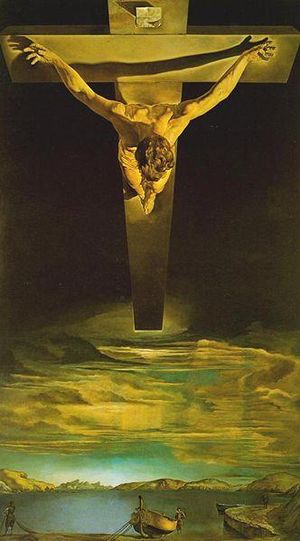
Salvadore Dali's painting, The Christ of St John of the Cross,
emphasizes perspective.) The dark night is a common step in coming out as gay. That is, gay men often experience confusion, depression, and loss of social identity as they realize their homosexual orientation. First, perhaps, we sense that something is missing in heterosexuality, we long for something more. Then when we realize what it is we long for, we may feel humiliated or betrayed or at least may feel this is something we must keep secret. Later, often through a life-changing moment of emotional intensity, we come to understand what homosexuality really is. Then the guilt and misconceptions are transformed, and we experience relief and joy. We have gone through the dark night, through the way of purgation, and discovered a whole new world and new self-concept. What St. John of the Cross was describing as a stage of the spiritual life--perhaps to keep his fellow monks from realizing he was tricking with an hallucinated Jesus out at the cruise park--was not the sadness and unhappiness of depression, but a state of uncertainty and not-knowing. This is a relatively enlightened stage of religiousness. And you find it among many of the mystics. They acknowledge that the spiritual life is not about being right. Rather it is about being in awe before a greater reality that just doesn't fit human ideas, because it is so much bigger, more wonderful, and more immediate. This embrace of uncertainty is not something you find in popular religion, however. The televangelists never say God is unknowable and religious people ought to give up trying to know who's right and, especially, who's wrong. Just the opposite, they often maintain they themselves know exactly what is in the mind of God, that their translation of the Bible is absolutely true and inerrant, that Church teaching is infallible. No room for uncertainty and unknowing here. Tragically, little room for spiritual growth and enlightenment either! Not surprisingly, gay men have a special access through the dark night. We go through that uncertainty as a necessary part of being who we are. And thus we potentially see the mystical message behind religion. We potentially discover what John of the Cross was talking about: in every man we meet, especially those we have sex with or fall in love with, we can see Christ. Indeed, this is what "Christ" means: not some Cosmic Pal in the sky who is the founder and CEO of Christianity, but the real divinity of human incarnate life, here and now. As Jesus said, "What you do to the least of my brothers, that you do to Me." And also: "The Kingdom of God is spread across the face of the Earth, and men do not see it." The trick is to open our eyes to see. The New Age singer Loreena McKennitt, who has put St. John's poem to music, translates his rhapsodizing this way: "O night that joined the lover to the beloved one, Transforming each of them into the other." (You can hear Lorenea McKennet's song on YouTube: The Dark Night of the Soul) That's a very homosexual take on lovemaking. While heterosexuals do experience love as a reuniting with their "other half" (following Plato's famous image), they generally don't experience transforming into one another. Straight men don't long to experience becoming women during sex; they don't confuse their penis with their partner's vagina. Gay men do. We can experience a blurring of identity in sexplay. In the fire of passion, we can sometimes confuse our own bodies and our beloveds'. We can experience transforming into one another. More importantly, we can experience sex and lovemaking as an experience of Christ, of God. This is the mystical vision of the dark night. Once Juan de la Cruz got out of his cell, by the way, by prying open the door to his cell and climbing out a window and down "a secret stair" (?), he continued his efforts to restructure the Carmelite Order according to the "Strict Observance," called "Discalced" (meaning barefoot or shoeless; Discalced Carmelites actually wear sandals, like most other mendicant friars in the Franciscan tradition). He was associated with the very dominant (and big-boned and butch) female saint, Teresa of Avila, who had first gotten the Carmelite nuns to discalce themselves and who had enlisted Juan to bring these reforms to the friars. Especially because of the Bernini sculpture of St. Teresa being pierced in the heart with a flaming arrow wielded by an angel, she has become famous for experiencing prayer-induced orgasm.
Remember
John wakes
to find
himself and
his Beloved lying in a field of lilies. A beautiful affirmation
of
love. Also an allusion to one of the loveliest of Jesus's sayings:
Consider the lilies of This is the message of the spiritual teachings: Live here and now. Find the Kingdom of God here and now. See Jesus in everyone you meet. This is not the wisdom of family values and householding which is understandably, desperately concerned with maintaining the status quo, holding on to certainty, protecting the nest for the sake of the children. But precisely because, as gay, we don't fit into the status quo, we don't experience certainty and righteousness, we have available to us the mystical vision of the dark night. We can open our eyes and see in the darkness. icon
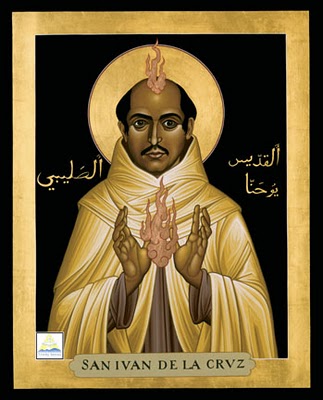
of St John of the Cross
© 1991 Br. Robert Lentz, OFM
Here's a lovely English translation of the poem by Kieran Kavanaugh, OCD, and Otilio Rodriguez, OCD: 1. One dark night, |
Toby Johnson, PhD is author of nine books: three non-fiction books that apply the wisdom of his teacher and "wise old man," Joseph Campbell to modern-day social and religious problems, four gay genre novels that dramatize spiritual issues at the heart of gay identity, and two books on gay men's spiritualities and the mystical experience of homosexuality and editor of a collection of "myths" of gay men's consciousness.
Johnson's book
GAY
SPIRITUALITY: The Role of Gay Identity in the Transformation of
Human Consciousness won a Lambda Literary Award in 2000.
His GAY
PERSPECTIVE: Things Our [Homo]sexuality Tells Us about the Nature
of God and the Universe was nominated for a Lammy in 2003. They
remain
in
print.












 Two
Spirits is available as an
audiobook narrated by Arthur Raymond.
Two
Spirits is available as an
audiobook narrated by Arthur Raymond. 
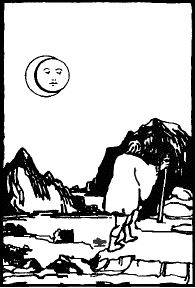 St.
John of the Cross spent a grueling nine months as a prisoner in a
monastery of the Order in Toledo.
He was kept locked up because, inspired by his friendship with his
fellow reformer, the Carmelite nun Teresa of Avila, he was so insistent
that the Carmelite
friars practice mortification and austerities. The other friars
had him sent to his cell to keep him quiet. He was flogged in front of
the community at least weekly. While locked away, he
wrote numerous poems and elaborate commentaries on these poems. Like
the spiritual poetry of the Persian Islamic Sufi mystics a few
centuries before, St. John's poetry is hotly homoerotic.
St.
John of the Cross spent a grueling nine months as a prisoner in a
monastery of the Order in Toledo.
He was kept locked up because, inspired by his friendship with his
fellow reformer, the Carmelite nun Teresa of Avila, he was so insistent
that the Carmelite
friars practice mortification and austerities. The other friars
had him sent to his cell to keep him quiet. He was flogged in front of
the community at least weekly. While locked away, he
wrote numerous poems and elaborate commentaries on these poems. Like
the spiritual poetry of the Persian Islamic Sufi mystics a few
centuries before, St. John's poetry is hotly homoerotic.