|
Contact Us Table of Contents Search Site Google listing of all pages on this website Site Map Toby Johnson's Facebook page Toby Johnson's YouTube channel Toby Johnson on Wikipedia Toby Johnson Amazon Author Page  Secure site at https://tobyjohnson.com  Also on this website: As an Amazon Associate
I earn from qualifying purchases. Toby Johnson's books: Toby's books are available as ebooks from smashwords.com, the Apple iBookstore, etc. FINDING
YOUR OWN TRUE MYTH: What I Learned
from Joseph Campbell: The
Myth
of the
Great Secret
III GAY SPIRITUALITY: The Role of Gay Identity in the Transformation of Human Consciousness
GAY PERSPECTIVE: Things Our Homosexuality Tells Us about the Nature of God and the Universe
SECRET MATTER, a sci-fi novel with wonderful "aliens" with an Afterword by Mark Jordan
GETTING
LIFE IN PERSPECTIVE:
A
Fantastical Gay Romance set in two different time periods
THE FOURTH QUILL, a novel about attitudinal healing and the problem of evil  TWO SPIRITS: A Story of Life with the Navajo, a collaboration with Walter L. Williams  CHARMED LIVES: Spinning Straw into Gold: GaySpirit in Storytelling, a collaboration with Steve Berman and some 30 other writers
THE MYTH OF THE GREAT SECRET: An Appreciation of Joseph Campbell
IN SEARCH OF GOD IN THE SEXUAL UNDERWORLD: A Mystical Journey
Books on Gay Spirituality: White Crane Gay Spirituality Series
Articles and Excerpts:
Review of Samuel Avery's The Dimensional Structure of Consciousness Funny Coincidence: "Aliens Settle in San Francisco" About Liberty Books, the Lesbian/Gay Bookstore for Austin, 1986-1996 The Simple Answer to the Gay Marriage Debate A Bifurcation of Gay Spirituality Why gay people should NOT Marry The Scriptural Basis for Same Sex Marriage
Gay ConsciousnessQ&A about Jungian ideas in gay consciousness What Jesus said about Gay Rights Common Experiences Unique to Gay Men Is there a "uniquely gay perspective"? Interview on the Nature of Homosexuality What the Bible Says about Homosexuality Mesosexual Ideal for Straight Men Waves of Gay Liberation Activity Wouldn’t You Like to Be Uranian? The Reincarnation of Edward Carpenter Why Gay Spirituality: Spirituality as Artistic Medium Easton Mountain Retreat Center Andrew Harvey & Spiritual Activism The Mysticism of Andrew Harvey
Enlightenment
Joseph Campbell's description of Avalokiteshvara You're Not A WaveJoseph Campbell Talks about Aging What is Enlightenment? What is reincarnation? How many lifetimes in an ego? Emptiness & Religious Ideas Experiencing experiencing experiencing Going into the Light Meditations for a Funeral Meditation Practice The way to get to heaven Buddha's father was right What Anatman means Advice to Travelers to India & Nepal The Danda Nata & goddess Kalika Nate Berkus is a bodhisattva John Boswell was Immanuel Kant Cutting edge realization The Myth of the Wanderer Change: Source of Suffering & of Bliss World Navel What the Vows Really Mean Manifesting from the Subtle Realms The Three-layer Cake & the Multiverse The est Training and Personal Intention Effective Dreaming in Ursula LeGuin's The Lathe of Heaven Gay
Spirituality
|
More than through organized religion, the way to achieve spiritual experience and to transform one's consciousness is through meditation practice. In Meditation Without Myth: What I Wish They'd Taught Me in Church about Prayer, Meditation, and the Quest for Peace, my friend Daniel Helminiak has written a wonderfully readable and wise book about meditation practice, but it's also a book about the "truth" about religion. The old myths that have come down to us--either as Christianity or  Buddhism or any other
religion--are so filled with the cultural artifacts of their times and
the elaborate metaphors that once meant something to people and gave
meaning to their life, but which don't fit into modern reality, that
they are outdated and "meaningless." But they have left us hungering
for "spirituality." Buddhism or any other
religion--are so filled with the cultural artifacts of their times and
the elaborate metaphors that once meant something to people and gave
meaning to their life, but which don't fit into modern reality, that
they are outdated and "meaningless." But they have left us hungering
for "spirituality."Helminiak is quite right that the churches fail to teach their members how to meditate or what to do to open their minds to the "greater reality" that the myths point to (but do not exhaust). The old religions about the power and authority of God and the Father and his personally composed Bible, though they make up a large part of the American psyche, don't really make sense anymore. The world of Genesis just isn't big enough to fit into the cosmos that science's telescopes have revealed. The God of the Bible is just too small and too provincial. A new myth is being developed in our time -- one that is open to spirituality, but that is not limited to the old time God. While Helminiak himself doesn't deal with this "new myth," his book is a marvelous 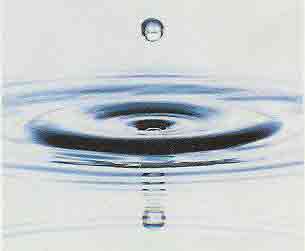 contribution towards its creation. contribution towards its creation.Nontheistic meditation is far more successful at inspiring people and giving a sense of meaning and vitality to their existence than childhood stories of pie-in-the-sky and disincarnate entities. It's time people begin waking up. This book is a great help!! I love the graphic on the front of Daniel's book. It is reminiscent of the lyric from the Grateful Dead song "Ripple" which has become a kind of personal koan of mine: Meditation The way to connect with the
greater
reality is through interior meditation. For meditation is about
experiencing and understanding the God within. Perhaps religious traditions are
needed
to transmit meditation techniques--though the church buildings
scattered across the landscape sometimes look like the source of more
harm than good, and in most of those churches people aren't learning
how to meditate. But meditation and religious practice are not mutually
exclusive. By taking up these practices, we follow in the
footsteps--and resonate with the vibes--of generations of gay men and
lesbians before us who entered contemplative and monastic life and
learned to practice interior prayer. It's not so simple though,
because
simply sitting means not doing anything else. This means you are not
thinking. 'Cause if you are thinking--or remembering, fretting,
anticipating, or planning--then that's what you're doing, not sitting.
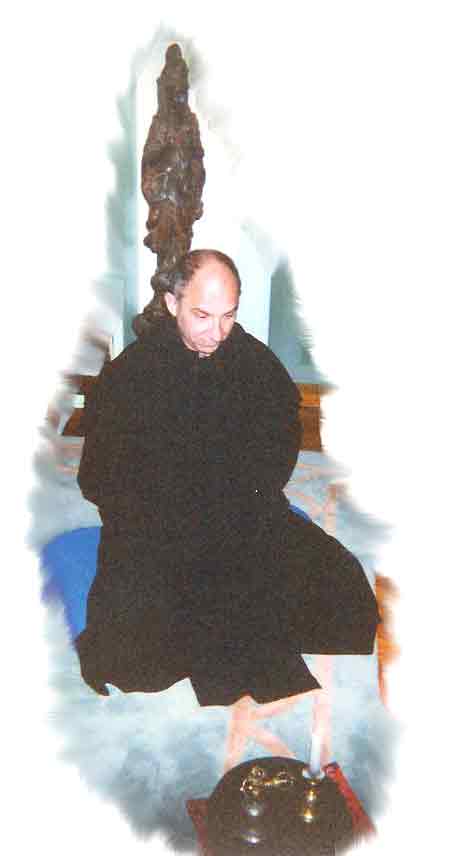
So the physical discipline is really a metaphor for a mental discipline. To meditate, sit comfortably in an erect, stable posture, preferably, but not necessarily, with your legs folded under you in the lotus or half-lotus posture and buttocks raised slightly with a pillow so that your spine is straight and elongated. You can close your eyes (Hindu style) or keep them open in soft focus on a spot an arm's distance in front of you (Buddhist style). Keeping your eyes open deters falling asleep. Rest your hands on your knees or cup them in your lap. Place the tip of your tongue lightly against the back of your teeth. Breathe regularly. Attend to your breathing and to the stability of your body. And hold the pose for 20 minutes. The amount of time you commit is up to you. 20 minutes is about the time it takes for the brain to fatigue and shift brain wave states, something akin to getting your "second wind" in athletics. However long you do it, you should decide the length in advance and stick to it. Set a realistic length and don't quit before the time is up. What you're feeling and thinking should have nothing to do with how long you maintain the practice. The success of the practice comes from doing it, not from your assessment of how well you think you're doing. That is, it has nothing to do with your ego. You can't do it wrong. So long as you sit for the time you predetermine, you're doing it right. You shouldn't daydream, fret about work, or plan your day's schedule, but if you do, then notice that and go back to just sitting. (Actually a lot of creative work and planning gets accomplished just in watching the stuff bubble up into awareness.) If you need to scratch an itch, blow your nose, take a drink of water, or shift because your legs have fallen asleep, do so. Then smoothly return to the pose. The effort to maintain your relaxed but erect posture and to stick to your time limit will keep reminding you you're meditating. And that's what meditation is. Here's
a photo of Toby costumed in his While you're sitting, time
passes, you
breathe, and you're aware. Focusing on the breath is the simplest
technique for calming what's called "the monkey mind"--the tendency of
the human mind to keep thinking and jumping from subject to subject. As
you focus on your breath or simply on the passage of time, you'll find
that monkey mind fills your consciousness with ideas, thoughts,
opinions, and considerations. Just let them go and return to your focus
of attention. In fact, by observing these fluctuations in consciousness
with equanimity and letting them go, you accomplish the major work of
meditation practice. Transcendental Meditation, the
movement
that with the help of the Beatles popularized meditation in the 1960s,
teaches the technique of mantra meditation: recollecting the sound of a
word given you by your teacher. T.M. says that the thoughts, memories,
and associations that arise during meditation represent unfinished
karma and unresolved business. Letting them come into consciousness
without reacting to them discharges the karmic or emotional bond.
Noticing them and then returning attention to the mantra gradually
washes them away in the sound of the mantra. This image also captures the healing power of psychotherapy. In the psychoanalytic technique of free association, the patient on the couch brings emotionally charged or repressed material into consciousness and discharges it by talking about it in a state of induced relaxation to his or her disinterested, non-reactive, and non-judgmental analyst. Other techniques for dealing with the monkey mind include gazing at an icon, holy object, or candle flame; chanting a sacred word or phrase; intentionally relaxing the body, alternating left and right, step by step, from feet to head; focusing awareness on the seven chakras (power centers in the mind/body); remembering a particularly joyful or meaningful experience (a high enlightened moment or even a state of transcendent sexual arousal); or simply reminding yourself "Be here now," that is, reminding yourself you're sitting and not doing anything else but sitting. Indianologist and gay mystic
Andrew
Harvey describes a wide range of meditation techniques in The
Direct Path: Creating a Journey to the Divine Through the World's
Mystical Traditions. Psychologist and former priest,
Daniel
Helminiak presents a wonderful discussion of meditation in the book Meditation
Without Myth: What I Wish They'd Taught Me in Church about Prayer,
Meditation, and the Quest for Peace.
Toby's altar with Tibetan
bell and vajra.
A simple technique to redirect this churning is to use, like a mantra, the question: "Who am I?" Such questions naturally arise as you sit. When you wonder "Who is meditating?" or "Who watches the thoughts come and go?," you discover "you" are not who you thought you were. The brain is always involved in a process of identifying, sorting, evaluating, and filing current sense experience by associating it with events in the past and anticipating events in the future. This processing is the content of our lives. It is the activity of our egos. Your perspective on experience determines how you think of yourself. It's what "you" are. But there's another you that observes the processing. Because the ego is usually obsessed with the process rather than with present experience, you often don't even know who you are. When it's not processed, experience is free of problems, suffering, fear, and desire. It's just what is, here and now. Meditation is training in letting go of the obsession with the processing, thus letting go of past and future. Meditation teaches you to be aware of the present moment without the intervention of the mind by attending to the silence between thoughts. The silence is the moment of now. A simple way to notice that
silence and
to drop the processing is to ask yourself: "What is my next thought
going to be?" The you that waits for the answer is not your mind. Your
mind is the processing function that produces the thought. But it's not
the watcher. To extend this exercise one step further, ask yourself: "What totally new thought am I going to have?" As the next thought comes up, observe it and see whether it flowed from what you'd been thinking previously. If it does, drop it; it isn't a new thought. Then wait for the next. When a truly new thought comes up, notice it and let it go, and watch to see whether the next thought is related to it. This practice keeps you mindful of the great silence from which thoughts emerge without letting you cling to any particular thought. The "usual you" is the thoughts.
Consciousness forgets itself every time it gets caught up in the flow
of thoughts, ideas, experiences, and desires that you think of as
yourself. When you allow thoughts to come and go, you can become aware
of the space between the thoughts--the silence, consciousness itself.
This emptiness between thoughts is the emptiness of space and the field
of infinite potentiality. Being aware of the emptiness is being one
with God. It is God--the One Mind--that is conscious in you. Through meditation you begin to
experience yourself as something deeper than the aggregate of your
day-to-day sensory experience. You begin to discover the difference
between experiencer and experience, between the dreamer and the dream,
or--in W.B. Yeats's famous expression--between the dancer and the
dance. Or, conversely, you discover there is no difference: There is no
experiencer, only experience; no dreamer, only dream; no dancer, only
dance. That is, there is no you separate from your experience, separate
from the universe, or separate from God. The you that seems
separate--your ego--is just the processing in your mind. It's not you.
You are the universe--God--looking at yourself from the perspective of
your history and placement in time and space. Another set of meditation techniques involve becoming mindful of the space of your body and of the various layers or "bodies" that surround and comprise your consciousness. Buddhist psychology calls these "sheathes." In meditation, when you
deliberately narrow
your focus and concentrate
on simply sitting and breathing, you can feel the different layers of
your own being. Most fundamental, of course, is your physical body,
made up of matter which is, in turn, composed of biochemicals,
molecules and elemental particles. Atomic physics has discovered that
these elemental particles are, in fact, mostly empty space--not things
at all but energy fields that whirl across the surface of
multi-dimensional space-time. From the perspective of the atoms that
constitute our physical bodies, we are vast beings, huger than
galaxies. The physical body is inert
matter, like
a rock or a pile of soil. One day this body will die and return to
dust. Even so, right now, it is your body and it is clearly something
more than material elements. It's alive. A complex array of biochemical
reactions enlivens the physical body, including the digestion of food
into fuel and the processing of that fuel with oxygen into energy. The
aggregate of these processes is called the breath body. It's what you
focus on in meditation practice; it's the "being alive" itself. The breath body is porous and interconnected with other beings. In every breath you inhale particles that have been part of other beings' bodies and respirations. In every inhalation there are molecules that have been breathed by all the people who've ever lived. Indeed, in every breath you take are oxygen atoms that Jesus exhaled preaching the Beatitudes and Hitler rallying his troops to war. Because we are living beings, we are constantly exchanging the matter we are made of. The exchange of biochemicals within this living matter directs the flow of vital energy. This is the hormonal body. It is also affected by biochemicals from the outside environment, like pheromones, the smells and biochemical emissions from other people that are inhaled by the breath body. Your nervous system organizes and orients the activity of the body. The sensations and brain activity that ride on the life energy of the body constitute the neuronal body. This is what makes you sentient, aware of what's going on. The breath body, hormonal/pheromonal body and neuronal bodies are referred to collectively as the vital body. The vital body enlivens the physical body and gives rise to mind and spirit. The mental body is your awareness, the "stuff" going on inside your head. Not only are you receiving sensory input from your neurons, you are also making sense of it, cognizing it. Spirit or soul is the part of you that responds to experience and makes decisions, assessments, and judgments. In human beings, sentience, mentation, cognition, and understanding produce yet another layer of experience. In this context, religion refers
to the
activities of the physical, vital, and mental bodies; sacraments,
rituals, and beliefs operate on these levels. One step up, spirituality
refers to the meaning behind the sacraments, rituals and beliefs. Thus
spirituality refers to the process by which human beings understand
individual experience and the relationship between individuals and the
cosmos. Spirituality refers to the operation of the radiant body. Not only are you aware, you are aware that you're aware. You can observe yourself. This is consciousness, the part of you that grasps your understanding. It's the observer that registers sensations and assembles a universe of meaning. It's what "you" are. But it's also more than just you. This observing consciousness is the true mystery that inspires spirituality today. This is what our myths of God are about. This is what the practice of meditation is about. This is the meaning of those curious Oriental statues of gods with multiple heads, one upon another: consciousness observing consciousness observing consciousness. By stilling sensory and mental activity, consciousness becomes aware of itself. There is yet another layer or
body that
surrounds us. This is the part of us This sounds a little magical
(and, in a
way, it is). It's also very basic and very familiar: Happy people make
the people around them happy. And the reverse is also true: Angry and
unhappy people make the people around them angry and unhappy. This outermost layer is comprised
of
mentation, awareness, understanding and intention. It can also be
called the light body or the radiant body. There are important parallels between meditation and sex--and, of course, important differences. Not all sex should be meditative. Sex with another person, especially a new potential lover, is almost entirely about the particulars. It's all about the senses, the experience of infatuation, and romantic love. But sexual arousal, either alone or with a regular partner, can be much more interior-focused. It can be about achieving states of transcendent consciousness. The replaying of karmic events and important memories can act like the techniques for discharging unfinished business. In masturbation--or perhaps in anonymous play at a sex club--that question "Who am I?" sometimes naturally arises. Sexual arousal can be an invitation to be mindful of consciousness--and to offer the greater consciousness pleasure and joy in creation. While
sex doesn't have to be meditation or prayer, it can still be more than
most of us make it. Sex--and especially masturbation ("soloving")--can
be
experienced as a practice of consciousness of God. Instead of thinking
of sex as wicked and ungodly--as the religions often enjoin their
flocks--we can experience sexual arousal as a journey of the soul into
sacred mythic space where the deep forces of life and embodiment and
autonomic, hormonal instinct for pleasure take over and allow ego to
dim. In this underworld--in the Greek mythological sense of a
subconscious, transpersonal substrate--sexual arousal is truly worship.
Indeed in gay personal ad jargon, body worship is a style of sex. It is
adoration, reverence, and love for the evolutionary forces that have
created the world we live in and shaped us into human beings--incarnate
consciousness. It is easier to be aware of the presence of God
during sex than at
almost any other time (except, of course, during meditation and ritual
when that's the point). Most things in our daily experience--driving a
car or baking a cake--require attention to the particulars of what
we‘re
doing. Sex isn't about particulars. When we understand sexual arousal
as participation in the joy of life celebrating incarnation, then it is
always an experience of God, of the élan vital loving life. Observe your own body in a full-length mirror, determining what you like and don't like about your looks. Honor your own body with the steady, consuming gaze you'd bestow on the body of any other attractive man standing naked before you. As you gaze at your body--perhaps
bringing yourself to sexual arousal--understand that what you're seeing
is what other people see (though you never see yourself the way others
do). This is how other people form their ideas of who you are and what
you're like. This is how they find you desirable. This is also how you
manifest yourself to yourself. This is how the spark of consciousness
that is you imagines, visualizes, and projects itself into
three-dimensional reality. Then let your perspective rise as you settle your gaze on your eyes. This reflection is the universe. Inside the body you observe, in its brain, behind its eyes, is the entirety of the world you experience. And you're outside observing it. See that you're not your body. You're the observer who experiences what's going on in that body, and who thinks in terms of the experiences that body has had. But you're something more. Your ego and self-image--all that stuff you think is so important--is just a reflection in the mirror of a consciousness that far transcends who "you" think you are. Tibetan Buddhists say the
practice of
mirror-gazing allows one to see one's past incarnations. As you look at
yourself in the mirror and peer deep into your eyes, let other faces
rise to awareness. Imagine that what you're visualizing is the karmic
patterns that intersect to shape your particular perspective. "You" are
all the people who lived before you and whose karmic resonances create
the context of your life. All the other beings are putting out vibes,
just as you're putting out vibes. That's what the universe is. Allow
that exalted vision to reside in and warm your chest and belly. Allow
yourself to be sexually aroused by your vision and to see how the vast
interplay of vibes comes into being in you as your flesh. Raise your
perspective above time and realize it's all happening simultaneously.
Be aware of your radiant body. In your mind's eye, see the radiance
surrounding you. If you bring yourself to
orgasm,
allow yourself to see it's "God" you're experiencing as pleasure. Feel
the orgasm in your radiant body and let your pleasure radiate good,
loving vibes. Beginning with the Big Bang, energy has flowed into being, forcing space to expand and creating the context in which the universe exists. Space, carrying activity across its surface, evolves from chaotic energy into hydrogen atoms, then helium atoms, then on up the ladder of being to stars and planets. From there, the process spawns living, reproducing molecules, then plants, sentient beings, intelligent life, consciousness, and finally God. God is the perfection of love, harmony, and beauty--the fullness of being, consciousness, and bliss. As we saw Teilhard hypothesized, once God evolves, it--or, mythically, "He"--pops out of time, becomes eternal, and coexists with all the stages of the process by which it developed through the universe. If the universe successfully evolves into God, then the being that is conscious in each of us self-aware sentient beings is God. If this is the case, "He" sees that everything is perfect in its place in the vast evolutionary pattern. There was never any such thing as evil. If God fails to evolve--perhaps, because we human beings render the Earth lifeless--then God, or at least this planet's part of the cosmic process, cannot pop out of time and observe that everything is good. Then everything isn't good; the process doesn't work out. The suffering and tragedy that generations of human beings and our predecessors have endured will have been for nothing. "Evil" will have won. We cannot tell where we are in the vast process. We cannot tell whether the being observing the universe through us is God existing co-eternally with the universe or just our individual egos suffering on their way to eventual oblivion. Faith that God exists is faith that the universe will work as it should, that evolution will create God. We must have faith that it will work because that faith creates the self-fulfilling prophecy that brings it about. To believe in God, then, is to believe that evil isn't real and that it will ultimately be redeemed. To believe in evil is to put out the vibes--to prophesy--that God will not succeed. To overcome the belief in evil, you have to overcome the polarities. You have to see beyond dualism. Our gay outsider's perspective and our ability to live beyond polarities makes us part of the self-fulfilling prophecy that God does exist. That faith allows us to abandon judgment and concern for laying blame and to see that everything is perfect. When God pops out of time, "He"
sees
all time in a single eternal moment. Similarly, when we see our lives
from the present moment, we pop out of time and discover that the
events of our lives comprise a single eternal moment, we discern how it
all fits together. There is nothing to regret, nothing to resent. Thus
we can forgive the universe, forgive all the individual assaults
against us, and forgive the past. We can let it all go. We can even forgive those
televangelists--even the ugly-acting minister from Oklahoma. For we can
see that it's not that they're wicked, but just that their vision of
God is too small. And they play an important role. By demonstrating how
polarization and wrong-making corrupt religion, they inadvertently
assist in its maturation into higher spirituality. By letting go of judgment and the
belief in evil, we participate in God's creation of Himself. Indeed our
experience within time is precisely God's experience outside of
time--everything is perfect because together we managed to create God
out of the cosmos. And wise old man Joseph Campbell
used
to say: "People ask me, ‘What about all the evil and suffering in the
world?' And I say, ‘It's great just the way it is.‘" He'd stutter a
little on the "g" and then shake his head as if in bewilderment that
anybody could imagine any other response. "What else can you say? This
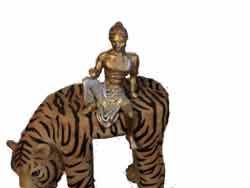
is the way it is." Avalokiteshvara sitting on a tiger
throne.
This statue, by Kip Dollar, is part of Toby's meditation altar. The story of Avalokiteshvara proclaims "The Way of Joyful Participation in the Sorrows of the World" As homosexuals who've been victims of that bullshit, we intuitively feel that Divine Impatience. Indeed, our impatience with "man's inhumanity to man" drives the gay cultural and political movement. That Divine Impatience is a spiritual manifestation of the physical expansion of the cosmos and the evolution of consciousness. Our efforts to achieve liberation and change the status quo--and our impatience with the social and, especially, religious forces that resist these efforts--is our participation in the creation of God. This is a vision beyond duality and polarization. Though it points toward issues far beyond sexual liberation and the rebellion at the Stonewall Inn, we can see that, precisely because it calls for rising above duality, it's an insight that gay people can readily grasp and that we dramatize with our lives. That's why it's something our homosexuality tells us about the nature of God and the universe. And it's something that tells us how to transform our lives. In religious mythological terms, this is called "saving the world." |
Toby Johnson, PhD is author of nine books: three non-fiction books that apply the wisdom of his teacher and "wise old man," Joseph Campbell to modern-day social and religious problems, four gay genre novels that dramatize spiritual issues at the heart of gay identity, and two books on gay men's spiritualities and the mystical experience of homosexuality and editor of a collection of "myths" of gay men's consciousness.
Johnson's book
GAY
SPIRITUALITY: The Role of Gay Identity in the Transformation of
Human Consciousness won a Lambda Literary Award in 2000.
His GAY
PERSPECTIVE: Things Our [Homo]sexuality Tells Us about the Nature
of God and the Universe was nominated for a Lammy in 2003. They
remain
in
print.












 Two
Spirits is available as an
audiobook narrated by Arthur Raymond.
Two
Spirits is available as an
audiobook narrated by Arthur Raymond. 
 Most
of the time our awareness tends to stay focused outside us. We live in
our eyes and see the contents of our consciousness displayed as the
outside world. When we sit in meditation we turn off the usual demands
of the senses and allow our consciousness to rise above the particulars
that drive our lives. By turning inward, we start to see subtle aspects
of our lives and our selves that are lost in the bright light of the
outside world. The stars are still above us during the day, but the
brightness of the sun makes them invisible. We don't see who we really
are because most of the time we're blinded by our minds churning away.
Most
of the time our awareness tends to stay focused outside us. We live in
our eyes and see the contents of our consciousness displayed as the
outside world. When we sit in meditation we turn off the usual demands
of the senses and allow our consciousness to rise above the particulars
that drive our lives. By turning inward, we start to see subtle aspects
of our lives and our selves that are lost in the bright light of the
outside world. The stars are still above us during the day, but the
brightness of the sun makes them invisible. We don't see who we really
are because most of the time we're blinded by our minds churning away.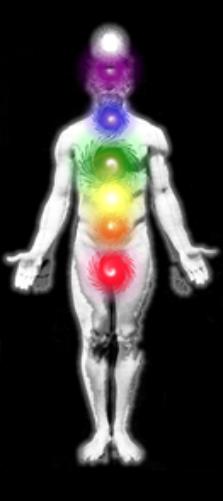 that gives off vibes. Modern radio and TV devices that
resonate with invisible waves in the electromagnetic spectrum offer a
metaphor for the "waves" or "vibes" that are radiated by sentience and
vitality. Just as the flow of electricity through a microphone or
camera can be modulated to produce waves that can be transmitted into
the environment and subsequently picked up by radio and TV receivers,
so the flow of electric charge and neurotransmitters in our bodies can
be thought to generate waves that can be picked up by other people. We
generate them and we receive them. We receive them from the people
around us and from the countless people who've lived before us. We may
even pick them up from people who'll live after us, since these
vibrations may transcend the sequence of time as we know it.
Metaphorizing them as waves offers a scientific way of modeling such
phenomena as telepathy, clairvoyance, prophecy, and past lives.
that gives off vibes. Modern radio and TV devices that
resonate with invisible waves in the electromagnetic spectrum offer a
metaphor for the "waves" or "vibes" that are radiated by sentience and
vitality. Just as the flow of electricity through a microphone or
camera can be modulated to produce waves that can be transmitted into
the environment and subsequently picked up by radio and TV receivers,
so the flow of electric charge and neurotransmitters in our bodies can
be thought to generate waves that can be picked up by other people. We
generate them and we receive them. We receive them from the people
around us and from the countless people who've lived before us. We may
even pick them up from people who'll live after us, since these
vibrations may transcend the sequence of time as we know it.
Metaphorizing them as waves offers a scientific way of modeling such
phenomena as telepathy, clairvoyance, prophecy, and past lives.