|
Contact Us Table of Contents Search Site Google listing of all pages on this website Site Map Toby Johnson's Facebook page Toby Johnson's YouTube channel Toby Johnson on Wikipedia Toby Johnson Amazon Author Page  Secure site at https://tobyjohnson.com  Also on this website: As an Amazon Associate
I earn from qualifying purchases. Toby Johnson's books: Toby's books are available as ebooks from smashwords.com, the Apple iBookstore, etc. FINDING
YOUR OWN TRUE MYTH: What I Learned
from Joseph Campbell: The
Myth
of the
Great Secret
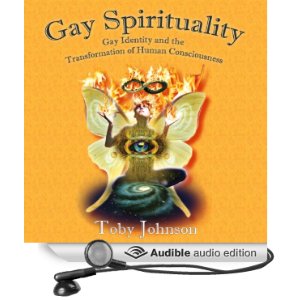
III GAY SPIRITUALITY: The Role of Gay Identity in the Transformation of Human Consciousness
GAY PERSPECTIVE: Things Our Homosexuality Tells Us about the Nature of God and the Universe
SECRET MATTER, a sci-fi novel with wonderful "aliens" with an Afterword by Mark Jordan
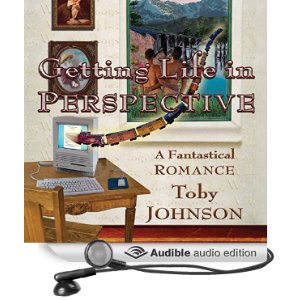
GETTING
LIFE IN PERSPECTIVE:
A
Fantastical Gay Romance set in two different time periods
THE FOURTH QUILL, a novel about attitudinal healing and the problem of evil  TWO SPIRITS: A Story of Life with the Navajo, a collaboration with Walter L. Williams  CHARMED LIVES: Spinning Straw into Gold: GaySpirit in Storytelling, a collaboration with Steve Berman and some 30 other writers
THE MYTH OF THE GREAT SECRET: An Appreciation of Joseph Campbell
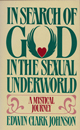
IN SEARCH OF GOD IN THE SEXUAL UNDERWORLD: A Mystical Journey
Books on Gay Spirituality: White Crane Gay Spirituality Series
Articles and Excerpts:
Review of Samuel Avery's The Dimensional Structure of Consciousness Funny Coincidence: "Aliens Settle in San Francisco" About Liberty Books, the Lesbian/Gay Bookstore for Austin, 1986-1996 The Simple Answer to the Gay Marriage Debate A Bifurcation of Gay Spirituality Why gay people should NOT Marry The Scriptural Basis for Same Sex Marriage
Gay ConsciousnessQ&A about Jungian ideas in gay consciousness What Jesus said about Gay Rights Common Experiences Unique to Gay Men Is there a "uniquely gay perspective"? Interview on the Nature of Homosexuality What the Bible Says about Homosexuality Mesosexual Ideal for Straight Men Waves of Gay Liberation Activity Wouldn’t You Like to Be Uranian? The Reincarnation of Edward Carpenter Why Gay Spirituality: Spirituality as Artistic Medium Easton Mountain Retreat Center Andrew Harvey & Spiritual Activism The Mysticism of Andrew Harvey
Enlightenment
Joseph Campbell's description of Avalokiteshvara You're Not A WaveJoseph Campbell Talks about Aging What is Enlightenment? What is reincarnation? How many lifetimes in an ego? Emptiness & Religious Ideas Experiencing experiencing experiencing Going into the Light Meditations for a Funeral Meditation Practice The way to get to heaven Buddha's father was right What Anatman means Advice to Travelers to India & Nepal The Danda Nata & goddess Kalika Nate Berkus is a bodhisattva John Boswell was Immanuel Kant Cutting edge realization The Myth of the Wanderer Change: Source of Suffering & of Bliss World Navel What the Vows Really Mean Manifesting from the Subtle Realms The Three-layer Cake & the Multiverse The est Training and Personal Intention Effective Dreaming in Ursula LeGuin's The Lathe of Heaven Gay
Spirituality
|
Here's a link to a wonderful 52 minute talk on YouTube about Edward Carpenter by Simon Dawson https://m.youtube.com/watch?v=B-ERNmNTkH0&t=441s And a link to edwardcarpenter.net Am I (or You) the Reincarnation of Edward Carpenter?
Edward Carpenter was born in Sunday, August 29, 1844 (coincidentally?!? the birthday of Karl Heinrich Ulrichs (1825-1895), his predecessor in proclaiming "gay consciousness"). Carpenter died on June 28, 1929 (exactly forty years before Stonewall ), long before what we think of as the currently modern age. 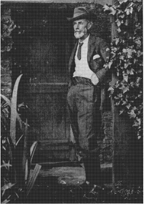 I want to make the case for why modern readers, especially gay men, should be interested in Carpenter's writings and his precocious ideas and why reading this present edition of The Intermediate Sex can offer an insight into the deep meaning of homosexuality and gay/queer consciousness. Though Carpenter's prose is typically 19th Century--overly polite, oddly punctuated, run-on, and circumlocuous--his ideas are surprisingly contemporary. The arguments he makes about homosexuality and associated morals sound like a manifesto of 21st Century queer liberation. Indeed, to a generation of modern queers who insist they don't want to be excluded as "different" or limited by labels like gay and straight, Edward Carpenter may seem downright radical. Partly this tells us that as an individual Carpenter was ahead of his times. But it also tells us that Victorian times were not nearly as stuffy, conservative, and repressed as we're likely to think. The great changes in human consciousness that have been wrought in the latter part of the 20th Century had been well-prepared for even a century before. The "Women's Movement" was already beginning. Carpenter was perhaps originally "politicized" into sexual liberation as a boy observing the lives of his six sisters. In his autobiography, My Days and Dreams, he commented that because his family was upper-middle class, though not necessarily wealthy, his sisters were doomed to lives of genteel boredom. They were "above" working or doing household chores; practically everything beyond dressing and dancing were "unladylike." Women obviously needed to be liberated from their fortunate status. Growing up with six sisters may also help explain Carpenter's own freedom from rigid sex role conformity. His ideas on monogamy sound like hippie counterculturalist ideals from mid-20th Century. In Love's Coming of Age, a book written about sexuality in general (i.e., primarily heterosexuality), he notes that in the long run people tend to settle down into one deep permanent union, but along the way they ought to be experiencing a variety of interpersonal relationships and sexual adventures. And he warns that the ideal of exclusive attachment can lapse into a mere stagnant double selfishness. That is, like today's sexual liberationists, he calls for love and devotion between individuals without the quality of their love being defined by exclusiveness based in jealousy, a petty sense of private property in the other person, social opinions, and legal enactments. These, he says, suffocate wedded love in egoism, lust, and, meanness. Most importantly, Carpenter writes positively of sex--"with a sense almost of religious consecration"--speaking of it as a good thing in human consciousness, not a sign or cause of human frailty and sinfulness. Sex is the allegory of Love in the physical world. It is from this fact that it derives its immense power. The aim of Love is non-differentiation--absolute union of being; but absolute union can only be found at the centre of existence. Therefore whoever has truly found another has found not only that other, and with that other himself, but has found also a third--who dwells at the centre and holds the plastic material of the universe in the palm of his hand, and is a creator of sensible forms. Notice that in the paragraph, just cited, though intended to be understood as about male-female bonding in marriage, the pronouns are impersonal enough to include homosexual bonding. And the aim he proposes for Love, "non-differentiation," is clearly something much more homosexual than heterosexual. Men in love with women hardly think of themselves as becoming non-differentiated from femaleness. Males in love with females do not think of themselves as becoming womanly, certainly not the same way that homosexual lovers think of themselves becoming one another. So it is kind of homosexual connection, generalized to the point of seeming to include male-female connections, that Carpenter offers as the immense power of Love (capitalized, perhaps, to accord it that "religious consecration"). Unlike most of his contemporaries, including the relatively gay-positive ones like Richard von Krafft-Ebing whose book was titled Psychopathia sexualis, Carpenter included homosexuality as part of a discussion of general sexuality and not as a pathology. Indeed, Carpenter predicted that homosexuality would be accepted as normal in human life. Though, of course, there's still much contention about this, his prediction has effectively become true. It is in his ideas about homosexuality, as exemplified in The Intermediate Sex (the introductory section of which appeared in the 1906 edition of Love's Coming of Age), that Edward Carpenter offers ideas that resonate with modern consciousness and that claim our present interest. -- He praised the blending of gender traits in what he calls "intermediate types" or "urnings," as was the popular self-chosen term of his day. (Urning is derived from "Uranian" which in turn comes from the recently discovered planet Uranus (1781) which was held to control homosexuals the same way Mars and Venus were held to control and/or symbolize males and females. "Uranus," by the way, "heaven," so Uranians are "inhabitants of heaven.") -- Carpenter placed the coming of age and consciousness of such Uranians as a part of the general transformation of consciousness that is modernity (symbolized by the astronomical discoveries of the modern era that, of course, included the planet Uranus). -- Carpenter wrote that homosexuality bestows beneficial traits, among these are religious and spiritual sensitivities and good interpersonal interactions. He notes that homosexuals are good counselors and go-betweens for men and women. -- He observed that the problems associated with homosexual behavior are caused by ignorance and repression, due to socially promulgated and perpetuated negative judgments (what we now call "homophobia"), not internal pathology of homosexuality itself. 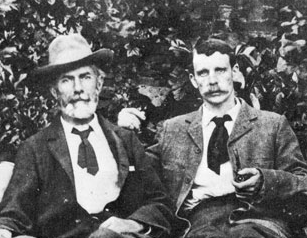 -- He saw that utopian styles of community living would be appropriate for homosexuals (and himself lived in a sort of rural community at Millthorpe Farm with his life partner George Merrill, welcoming a host of visitors over the years). -- He even declared that homosexuality retards aging, something the youth-obsessed first generation of liberated gay babyboomer men are living out in the current day. -- Carpenter defended homosexual lifestyles as answers to overpopulation pressures and natural forms of controlling population. (Thomas Malthus's ideas on overpopulation had been published in 1798, when world population was at about 1 billion, a hundred years before Carpenter's Love's Coming of Age. And here we are at the beginning of the 21st Century, another hundred years later and 5 billion people more, and the warnings are still not being heeded.) As I have been reading Carpenter's writings, I have been impressed and amazed at how prescient he appears to have been. Many of these points I've just mentioned are things I've been writing about myself in these gay liberation and post-liberation days around the turn of the 3rd Millennium--and thinking I was being insightful and relatively original. They hardly seemed like 19th Century ideas. How is this? Did Carpenter have the ideas first? Were they original to him? Or would he have had the same experience of discovering that his ideas had really come from his own predecessors? And then who were they? And how we could be having these ideas, handed down by him without most of us ever even having heard of Edward Carpenter? In the New Age-influenced thinking of modern gay mythologizing, I've asked myself the whimsical --and only partly self-aggrandizing--question: Am I the reincarnation of Edward Carpenter? Perhaps there is a better way to conceive of that egotistical conceit, one that hints at a deeper perception of what consciousness itself is and what homosexuality is within such a perception. Let's ask the question a different way. Is there something intuitive and automatic that all homosexuals realize? Realize, at least when they seek to delve deep into their experience of themselves. Obviously, many people, including many gay people, never really ask themselves deep questions like this. Though homosexuals are probably more inclined than the general population to ask them because, in the process of coming out, we are forced to consider why we feel ourselves different from other people. We're forced to think about the nature of consciousness itself. Is there a gay intuition of a uniquely "gay" secret knowledge? These questions suggest a more sophisticated way to understand the phenomenon referred to as "reincarnation" than contained in the popular "New Age" conceptions. Rather than as an individual soul that passes from one lifetime to another in temporal sequence, perhaps what "reincarnates" is the resonances from the lives of those who've lived before us. It isn't so much a soul that moves from one life to another, as the "karmic vibrations" of each life that continue to ripple through space-time-consciousness to influence the lives of those who will live later. Rather than a process of transmigration--like a soul transplant--what reincarnation mythology points to is more like broadcasting a radio or TV signal. The vibrations go out into the "ether" and are received by other individuals who are properly "tuned" to receive them. In such a conception, reincarnation is more like a metaphor for intuition than it is a metaphysical explanation for survival beyond death. (Though this observation does not exclude the possibility of life beyond death or of transmigration of souls.) Perhaps what we see that causes us to resonate with the thoughts of Edward Carpenter is a shared reality of common "karmic" resonances from the lives of all the homosexuals who've lived before. The source of our queer gay identity is our intunement with the souls of our predecessors. 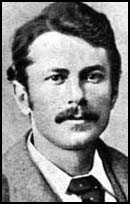 So then we might say, speaking mythologically, that we are all incarnations of Edward Carpenter, as he was incarnation of all those who'd lived before him. This is the understanding that my own life has led me to. Being gay is resonating with a pattern in the cosmic/planetary/collective mind (which is mythologized and anthropomorphized as God). Our gay spirituality then is to participate fully in this pattern AND to contribute to the pattern by ever improving its usefulness and enjoyment by the collective mind. That is, because we resonate with a pattern in the Mind of God--which is ever struggling to become more fully conscious of Itself through human beings--we experience the spiritual impulse to improve the human race. That is one of our functions in human evolution, a "procreation" of culture and awareness. A practice for participating in the collective pattern of what Edward Carpenter would have called Uranian or Intermediate Type and we'd call gay or (with some caveats) queer is simply becoming aware of the scope of the pattern. 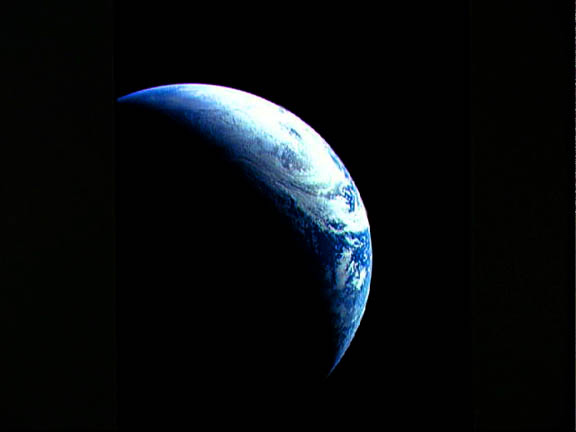 A parallel practice for participating in the growing self-awareness of planet Earth is going out at dawn and dusk to observe the movements of the Sun and Moon in the sky as our planet moves in conjunction with them. From gazing out at the night sky and observing the celestial bodies, we become aware of our place in the larger universe. We see the hugeness of it all. We are moved to wonder. Looking down into history and the expanse of time before us is a way of experiencing the scope--the hugeness--of collective mind, just like looking out at the night sky. So reading Edward Carpenter's writings, though a little dated in scientific perspective and a little quaint in style and composition--for those very reasons--is expanding your awareness of time and your awareness of the scope of your gay consciousness. I think these observations are very consistent with Carpenter's way of thinking. I think I am resonating with him when I offer these as a case for why modern readers should be interested in a book written a century ago. I have to acknowledge that I couldn't find my proposal about the nature of reincarnation in Carpenter's writings* (so I'll have to call that an improvement I'm making to our collective consciousness). But I did find in his later book fleshing out the historical spiritual and religious aspects of Uranian consciousness, Intermediate Types Among Primitive Folk, a strong sense that intermediate types--us homosexuals--are gifted with divinatory and psychic powers. *The White Crane mailer for Carpenter's birthday reports: In May 1928 Carpenter suffered a paralytic stroke rendering him almost helpless. He lived another 13 months before he died on a perfect summer afternoon, Friday June 28, 1929. On Decvember 30, 1910 Carpenter had written: So the invitation is for the reader to see a level beyond the words that follow, down into the spiritual mind of the gay and lesbian, homosexual throngs who have lived before us and sought to understand what was special about them and then to validate that discovery as their contribution to the evolution of life on Earth. The Gay SuccessionIn the process of researching Carpenter on the Internet, I came across a fascinating article (on the Gaysunshine website - http://www.leylandpublications.com/) from Gay Sunshine editor Winston Leyland's Gay Roots, Vol. 1, titled "The Gay Succession." In 1967, gay Beat poet Allen Ginsburg interviewed Gavin Arthur (grandson of U.S. President Chester A. Arthur, world traveler and adventurer, and later San Francisco astrologer and companion of Sufi Sam), about his experience as a young man of 23 of visiting Carpenter in England and having sex with the then 80 year old. Carpenter had told Arthur of his own sexual experience, as a 33 year old man, with American arch-poet and prophet Walt Whitman, then 58. When the young Arthur asked how Whitman had made love, Carpenter replied, "I will show you." The account of their night together is very sweet. Ginsburg discovered what he called a line of "Gay Succession" from Walt Whitman to himself. Walt Whitman (1819-1892) slept with Edward Carpenter Edward Carpenter (1844-1929) slept with Gavin Arthur Gavin Arthur (1901-1972) slept with Beat poet Dean Moriarty Dean Moriarty, a.k.a. Neal Cassady, (1926-1968) slept with Allen Ginsberg Allen Ginsberg (1926-1997) slept with ... This describes what we now call "degrees of separation." Well, I want to claim a place, albeit a secondary place, in that line of succession myself. When I was interning in Counseling Psychology (with a specialization in gay peer counseling) at the Integral Counseling Center of the freestanding graduate school in San Francisco now called C.I.I.S. (California Institute of Integral Studies) in 1976, I had a client in growth-oriented psychotherapy, part of whose story was that he'd been, as he proudly called himself, "Allen Ginsburg's bum-boy." Now I didn't have sex with my client (whose name is lost in my process of confidentiality: my appointment book only shows him as M.O.), so that broke the sexual component of the line of succession. But my role as a gay therapist was for years more central to my identity as a gay activist than my sexual exploits. So I am pleased to claim my place in six degrees of separation from Walt Whitman and five from Edward Carpenter. (In a different essay, maybe, I will report on my concomitant claim to be only three degrees from Kevin Bacon--also through a psychotherapy client.) For all that Ginsburg's Line of Succession--and my own six degrees of separation--is mostly camp and tongue-in-cheek, it is another kind of example of looking down into history and finding our connections with a rich, though secret, culture of our homosexual predecessors. Though we certainly can't identify the steps, I wonder if in similar fashion we may almost all of us be connected all the way back to Plato and Socrates and maybe even Jesus (who knows?). There is a corollary to this observation. In the Line of Succession as it appears in Winston Leyland's Gay Roots, Vol. 1, there are those dots after "Allen Ginsburg slept with . . ." My client M.O. was certainly not the only fellow through whom Ginsburg passed the torch of succession. And while many of those torchbearers died in the epidemic of the 1980s, many of them are still alive, some probably not even so old. The sweet story that Gavin Arthur told of his youthful experience of meeting the elderly Carpenter reminds us that there is a lesson about bridging the generational divide that we all can benefit from. Part of the discovery of reading Edward Carpenter's writings is seeing that there is not so much difference between people on the inside, no matter what their ages or time in history. We'd all benefit by overcoming the "age-ism" that characterizes (and complicates) so much of contemporary American--and, in particular, gay--culture. (See Toby's article on Ageism.) So, to put it bluntly, there are certainly men still living who tricked with Allen Ginsberg, and doubtless remember, who are probably now in their 50s, 60s, even 70s, who'd be quite happy to include earnest young queer men within the six degrees of separation from Walt Whitman. Those young men ought to be keeping their eyes open for those elders with their special gift of historical transcendence! Seriously, though, these considerations do remind us of our deep identity--beyond names and words (like gay and queer) and debates about essence and construction--that found our place in the great evolution of life on Earth and especially in the evolution of spiritual awareness and vision beyond the surface of things. That sense of the Uranian role in spiritual evolution is certainly one of Edward Carpenter's central ideas we can all resonate with. And it can be the important reminder that we find in that so terribly old-fashioned name for ourselves: by our homosexuality, we are inhabitants of heaven. What a wonderful--and necessary--realization! What a wonderful legacy for Edward Carpenter to leave us all! |
Toby Johnson, PhD is author of nine books: three non-fiction books that apply the wisdom of his teacher and "wise old man," Joseph Campbell to modern-day social and religious problems, four gay genre novels that dramatize spiritual issues at the heart of gay identity, and two books on gay men's spiritualities and the mystical experience of homosexuality and editor of a collection of "myths" of gay men's consciousness.
Johnson's book
GAY
SPIRITUALITY: The Role of Gay Identity in the Transformation of
Human Consciousness won a Lambda Literary Award in 2000.
His GAY
PERSPECTIVE: Things Our [Homo]sexuality Tells Us about the Nature
of God and the Universe was nominated for a Lammy in 2003. They
remain
in
print.
FINDING
YOUR OWN TRUE MYTH: What I Learned from Joseph Campbell: The Myth
of the Great Secret III tells the story of Johnson's learning the
real nature of religion and myth and discovering the spiritual
qualities of gay male consciousness.










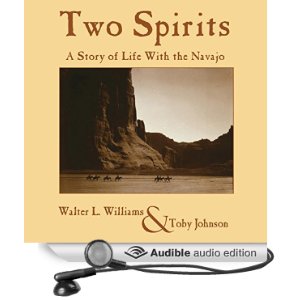 Two
Spirits is available as an
audiobook narrated by Arthur Raymond.
Two
Spirits is available as an
audiobook narrated by Arthur Raymond.